Sandalwood Essential Oil Uses and Benefits in Massage Oil Blends
Sandalwood is one of the most recognised base notes in massage oil blends. Here's what it brings to touch, mood, and an evening, and where it shows up in Wildfire's oils.
What is sandalwood essential oil used for in massage oil blends?
Sandalwood is a slow-growing wood with a scent that seems to carry that patience. In aromatherapy, perfumery and massage, sandalwood essential oil is commonly used for its warm, woody character, which is often experienced as grounding or calming.
Australian sandalwood (Santalum spicatum) grows naturally across the arid rangelands of Western Australia, where it has been part of the landscape and the lives of Noongar peoples for thousands of years.
Today, commercial harvesting and regeneration of wild Australian sandalwood are managed by the Forest Products Commission of Western Australia under legislation designed to regulate harvesting and support regeneration. As Indian sandalwood became increasingly scarce due to decades of unregulated harvesting, Western Australian sandalwood has become an important alternative, particularly where it is sourced through managed or plantation-backed supply.
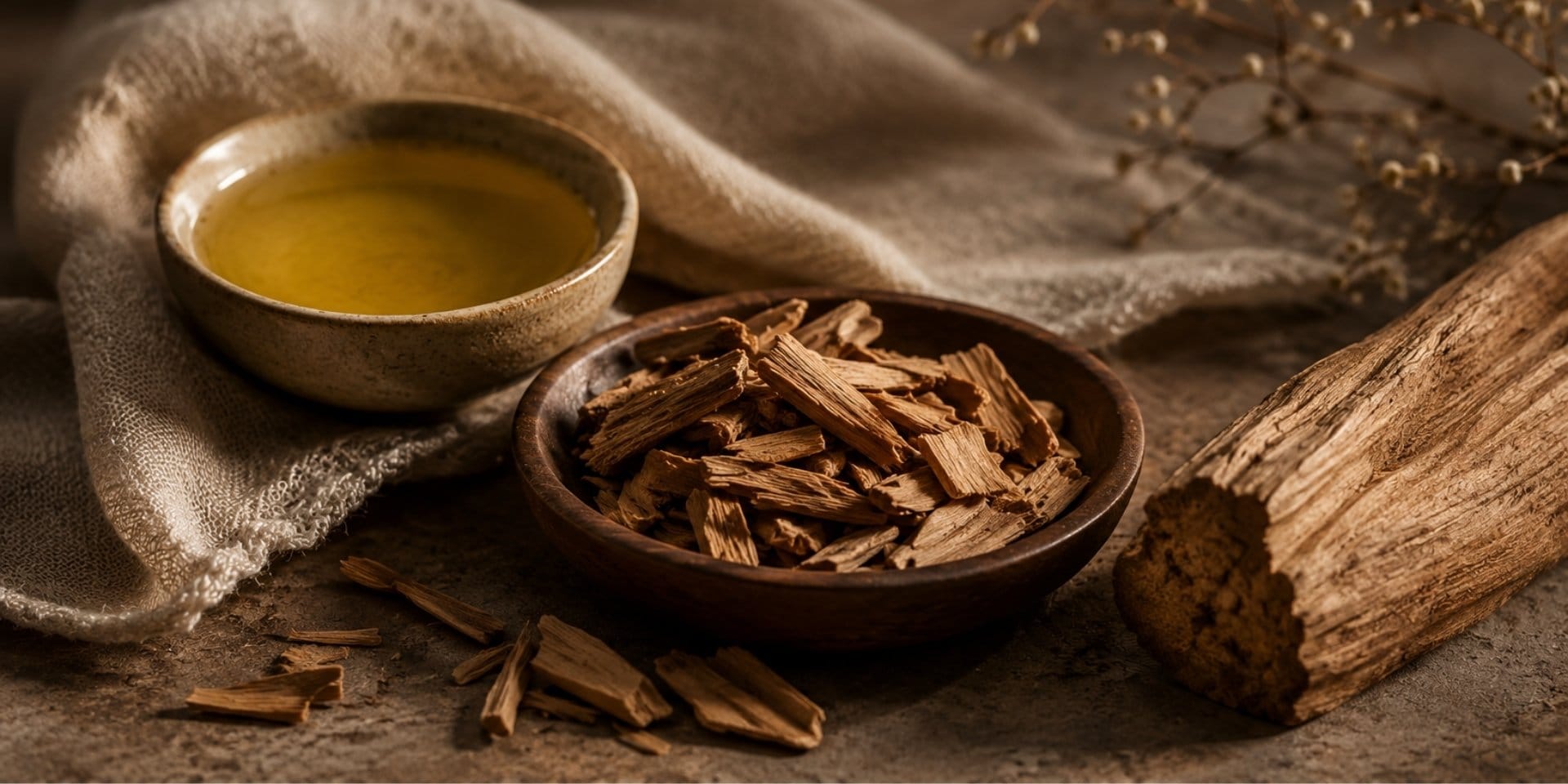
The oil is steam-distilled from the heartwood of mature trees, and it carries a character that reflects how slowly that wood develops: warm and woody, with a greener, fresher top note than its Indian counterpart.
Why sandalwood works as a base note in massage oil blends
Sandalwood functions as a base note in massage oil blends because its larger, heavier molecules are less volatile, meaning the scent evaporates slowly, anchoring the fragrance of a finished oil across the full length of a massage rather than fading early.
Fragrance notes are often described in terms of how long they last once applied. Top notes make the first impression but fade relatively quickly once warmed against the skin. Base notes are the opposite: slower to emerge but longer to linger, providing the scent that remains after the lighter notes have settled or lifted.
Sandalwood is one of the most widely recognised base notes in both fine fragrance and aromatherapy blending, valued precisely because it holds and extends the notes it is paired with rather than competing against them.
In the context of massage, where an oil is present on the skin for an extended period, this quality is especially useful. The scent does not disappear partway through the experience. It carries through, and it tends to remain on the skin after the massage has ended, quietly marking the time that follows.
- Top notes in a blend tend to fade quickly once warmed against the skin.
- Sandalwood's larger molecular structure means it evaporates slowly, holding the blend together over a longer massage.
- This is why it is typically used as an anchor rather than a headline note in a finished oil.
What sandalwood brings to touch and mood in a blend
Sandalwood is commonly used in aromatherapy for its warm, woody scent, which is widely regarded in traditional practice as grounding or calming, making it a natural choice for massage contexts where the intention is presence and connection rather than stimulation.
Sandalwood has been used in aromatherapy and traditional practices for its emotionally grounding qualities, a use noted by Australian aromatherapy educators and supported by its long cross-cultural history in ceremony, meditation, and ritual.
Sandalwood is widely used in aromatherapy and perfumery for its warm, woody scent, which many people associate with relaxation, grounding and a slower mood. Australian government sources also document the long history of Western Australian sandalwood and the regulated management of the resource today.
None of this constitutes a medical claim. What it reflects is a long, consistent pattern of human experience with a particular scent, one that many people still reach for when they want a massage to feel settled and unhurried rather than bright and energising.
That quality, present without demanding attention, suits a massage where the scent is meant to support the experience of touch rather than become the centre of it. A calming or grounding note sits differently during a massage than a stimulating one does. It tends to become something felt in the background rather than consciously noticed, which allows the experience of touch to stay in the foreground. This is part of why sandalwood recurs so consistently in blended massage oils designed for connection and relaxation, rather than oils built around alertness or energy.
Why sandalwood essential oil uses and benefits are best experienced in a blend
The uses and benefits of sandalwood essential oil are almost always best accessed through a properly diluted blend rather than pure oil applied directly to the skin, because undiluted essential oils are highly concentrated and not suited to direct topical use.
Professional aromatherapy safety guidance generally recommends that essential oils be properly diluted before topical use.
For massage, this is why sandalwood is best experienced as part of a finished oil blend rather than used on its own. A considered, pre-formulated massage oil removes the guesswork and allows the scent to be enjoyed in a ready-to-use form.
For people with sensitive skin, those who are pregnant or breastfeeding, or those managing an existing health condition, checking with a healthcare professional before introducing a new essential oil blend into a routine is a sensible precaution. A patch test on a small area of skin before wider use is also a reasonable habit with any new oil or blend.
Sandalwood and skin during massage
Sandalwood is sometimes discussed in relation to skin, but in the context of massage oil blends, its primary role is as a scent note within a diluted carrier oil formulation designed for body massage and touch, not as a facial skincare or skin treatment ingredient.
This distinction matters for anyone researching sandalwood benefits online and finding skincare-specific claims about acne, inflammation, or face oil applications. Those applications belong to a different category of product entirely, one built around different concentrations, different usage contexts and different carrier oil choices.
In a massage oil blend, sandalwood sits within a finished formulation designed to glide comfortably across the skin of the back, shoulders, arms and legs during massage.
The carrier oils underneath it, typically jojoba or olive, provide the glide, absorption and comfort on skin during touch. Sandalwood contributes scent rather than texture, which means the practical skin experience of the massage is shaped more by the carrier oil than by the essential oil notes sitting within it.
Where sandalwood shows up in Wildfire's massage oil blends
Wildfire does not sell sandalwood essential oil as a standalone product. Sandalwood appears as a grounding base note within selected Wildfire pleasure oils, where it is already diluted and blended with complementary botanicals.
Wildfire is an Australian brand dedicated to connection and self-care, creating pleasure oils, arousal oils, mood mists and essential oil blends designed to support intentional touch and atmosphere.
Every formulation begins with how individual notes work together rather than in isolation. Sandalwood appears in selected Wildfire pleasure oil blends as a grounding note that supports the wider scent profile.
The blend has already been carefully developed, so the finished oil is ready to use for body massage rather than left for the person using it to work out at home.
- Original pleasure oil pairs sandalwood with ylang ylang, rose geranium, and lavender, carried in jojoba and olive oil for a calm, grounded scent suited to relaxed, unhurried massage.
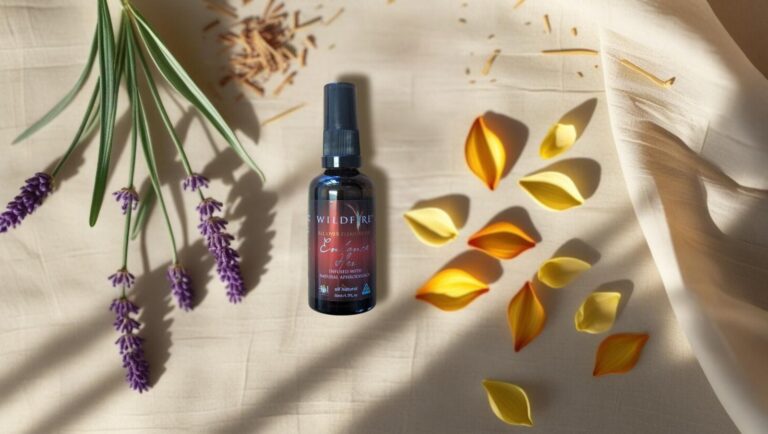
- Enhance Her pleasure oil includes sandalwood within a softer botanical blend designed for body massage, comfort and slow, intentional touch.
For more options, explore Wildfire's massage oils, designed for body massage, connection and slow, intentional touch.
Common questions about sandalwood in massage oil blends
What are the main uses and benefits of sandalwood essential oil in massage?
Sandalwood is commonly used in massage oil blends for its warm, grounding scent, its role as a long-lasting base note, and the sense of calm many people associate with it during touch. It works best as part of a diluted, balanced blend rather than applied as a pure oil.
Why is sandalwood used as a base note in massage oil blends?
Its larger, heavier molecules are less volatile, which means it evaporates slowly. This allows it to anchor a blend and hold its scent across a longer massage rather than fading partway through like lighter top notes.
Can sandalwood essential oil be applied directly to skin during massage?
Pure essential oils are highly concentrated and are generally diluted in a carrier oil before topical use. A pre-formulated massage oil takes care of this step before the product reaches you, so sandalwood can be experienced as part of a finished blend rather than applied on its own.
Does Wildfire sell pure sandalwood essential oil or a dedicated sandalwood massage oil?
No. Sandalwood appears as an ingredient within selected Wildfire pleasure oils, such as Original and Enhance Her, where it functions as a base note within a finished blend. Wildfire does not sell standalone sandalwood oil or a product marketed specifically as a sandalwood massage oil.
What does sandalwood pair well with in a massage oil blend?
It is frequently paired with florals like ylang ylang and rose geranium, which add lift and sweetness to balance sandalwood's deeper woody character, and with lavender, which adds a calming herbaceous quality that complements its grounding nature.
Is Australian sandalwood sustainably sourced?
Western Australian sandalwood (Santalum spicatum) is managed under legislation designed to regulate harvesting and support regeneration. The Forest Products Commission of Western Australia oversees harvesting limits and regeneration programs, and an estimated 20,000 hectares of plantation now supplement the wild resource to ensure long-term supply.
Further reading
- Forest Products Commission of Western Australia, Sandalwood: wa.gov.au/organisation/forest-products-commission/sandalwood
- National Association for Holistic Aromatherapy (NAHA), Essential Oil Safety: naha.org/explore-aromatherapy/safety
- International Federation of Professional Aromatherapists (IFPA): ifparoma.org
If a scent that settles into an evening rather than demanding attention sounds like what you are looking for, sandalwood is worth experiencing the way it was intended: as part of a blend built for touch.