
In this issue
Attention · Permission · Connection
What a Kiss Can Hold
What one small gesture can teach us about attention, permission and the courage to be close.

There is a moment before a kiss when nothing has happened, yet something is already being asked.
A face draws nearer. Conversation quietens. The space between two people becomes smaller, but more noticeable. In that brief pause, each person is reading the other: an expression, a movement, a willingness to stay.
Familiarity can make this moment almost invisible. We kiss hello, goodbye or goodnight without thinking about how much interpretation once preceded the gesture. Yet a kiss is never understood by touch alone. Its meaning depends on who is sharing it, what has been communicated and whether both people feel free within it.
Closeness is not created by distance alone.
This issue begins in that small space before contact, where affection is not yet a certainty and attention still matters.
What are we asking a kiss to carry?
The Meaningful Conversation
The changing language of a kiss
Are we really kissing less?
In August 2026, reports began asking whether Britain was experiencing a “kissing recession”. A YouGov survey commissioned by oral-care brand Waken found that more than one-third of British adults surveyed were kissing romantically less often than they had five years earlier. Almost one in five said they had not been kissed romantically in more than a year.1
Among younger adults, the hesitation was not always a lack of desire. Some worried about misreading the moment or being judged for their inexperience. Others described feeling less comfortable with unplanned, face-to-face interaction.
The findings belong to one commercially commissioned survey in one country. They cannot establish a worldwide decline, and counting kisses cannot tell us whether people feel close. The story travelled because it touched a more familiar concern: that constant communication has not necessarily made intimacy easier.
We can send hearts, kisses, photographs and messages throughout the day without having to read the pause in another person’s voice or the change in their posture. Physical affection can also occur under observation. A private moment may become someone else’s recording, stripped of its context and opened to public interpretation.
Research across Poland, Nepal and Indonesia adds another layer. In a study of 461 adults, greater willingness to express affection in both public and private settings was positively associated with relationship satisfaction in all three countries, although the associations were weakest in Nepal. Because the study measured correlations, it cannot tell us whether affection increases satisfaction, satisfaction makes affection easier to express, or both. What it does show is that affection and relationship satisfaction can remain connected even as cultural rules shape where and how tenderness is shown.2
The more interesting question, then, may not be how often people kiss. It may be whether the kiss still feels like a meeting between two people rather than a habit, a performance or a test.
The meanings we inherit
Romantic kissing is often presented as instinctive and universal. Cross-cultural research complicates that idea. An examination of 168 societies found evidence of romantic and sexual kissing in fewer than half of those studied. Affection, desire and commitment are expressed in many other ways.3
Even where kissing is familiar, it has never carried only one meaning. In The Kiss: A History of Passion and Power, Australian historian Professor Katie Barclay traces a thousand years in which kisses have communicated peace, loyalty, worship, status, romance, protest and power.4
In medieval Europe, a kiss could conclude an agreement or formalise loyalty between a ruler and a vassal. The place kissed, whether lips, hand, cheek or foot, could signal equality, reverence or submission. Later, handshakes displaced some public forms of kissing, while kissing on the lips became increasingly associated with private romantic and sexual life.
During the twentieth century, the kiss became a subject of public-health warnings and film censorship. It also became a form of political visibility. Queer activists used public “kiss-ins” to place tenderness in spaces where their relationships had been denied or condemned.
A history of kissing is therefore also a history of permission and power. Who may initiate, who may refuse, who may be seen and what a society permits people to express all shape the encounter. The smallest gestures are never empty; we fill them with the meanings of our time.
When familiarity starts writing the script
Stories often use a kiss to move the plot forward. It confirms attraction, resolves tension and opens the next scene. That narrative can quietly enter real relationships, where affection begins to feel less like a moment and more like the first step in a familiar sequence.
A massage may be interpreted as an invitation for sex. A hand placed on the body may be received as a question that already expects a particular answer. A kiss may begin to feel risky because declining anything that follows could disappoint the person who initiated it.
The pressure is not always deliberate. One partner may believe they are expressing desire while the other experiences obligation. One may hear hesitation as rejection, while the other is only asking for the freedom to enjoy affection without committing to more.
Once a small gesture is made responsible for proving attraction, security or the health of an entire relationship, both people can become guarded. Affection becomes something to interpret correctly rather than something they are able to inhabit together. A gesture does not have to lead somewhere to take us closer.
This is one reason technique can only take us so far. Advice about kissing often concentrates on pressure, timing and where to place a hand. These details may matter, but none can substitute for noticing whether another person is moving closer, becoming still or responding with genuine enthusiasm.
Consent is sometimes described as though it interrupts spontaneity. In practice, freedom can make spontaneity possible. When a person knows that yes, no and not now will all be received with care, they no longer have to manage closeness through avoidance.
This remains true in relationships that have lasted for years. Familiarity can create a beautiful knowledge of another person, but it cannot make that person permanent or entirely known. Bodies change. Preferences shift. Stress, health, grief, parenthood, confidence and the seasons of a relationship can all alter how affection feels.
Continuing to notice a partner is not evidence that we know them less. It is an acknowledgement that they are still becoming, and that being close does not remove their capacity to surprise us. Closeness begins where assumption ends.
None of this means every relationship should contain more kissing. Romantic kissing is not a measure of love, compatibility or intimacy. What matters is whether the gesture remains responsive to the people sharing it now.
The Sacred Ingredient
Ylang Ylang
A flower whose fragrance has long belonged to shared spaces.
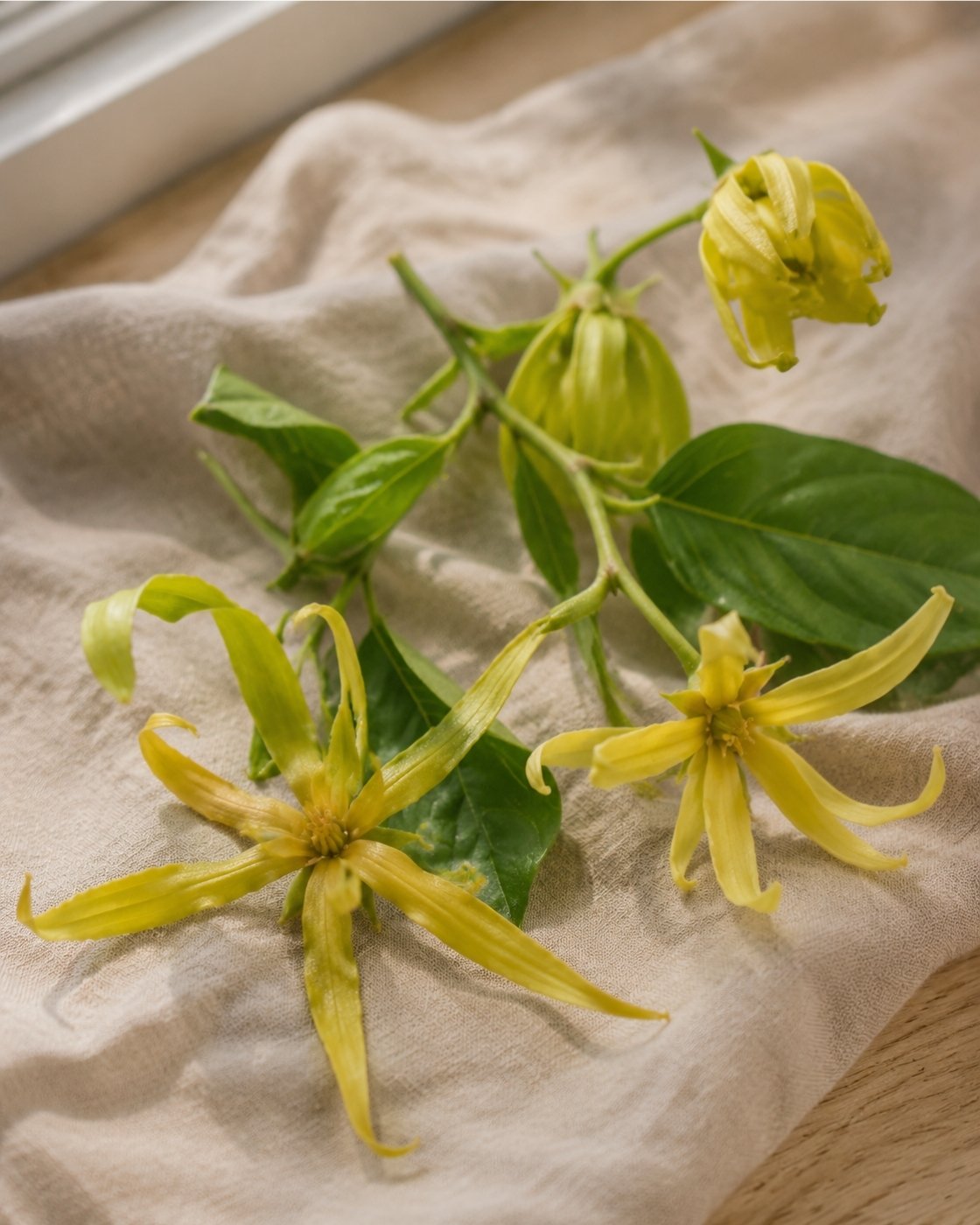
Ylang ylang does not resemble the flowers that usually dominate romantic imagery. Its long, narrow petals hang downwards from the tree, beginning green and maturing towards pale yellow. The fragrance they release is much larger than their delicate appearance suggests.
Known botanically as Cananga odorata, ylang ylang is native across parts of Southeast Asia and the western Pacific, with a natural range extending into Queensland.5
Its flowers have been used for personal adornment, festive decoration and ceremony. Ethnobotanical records describe them being placed on the beds of Indonesian newlyweds, allowing fragrance to accompany the transition from public celebration to private life.6
The essential oil is produced by distilling the flowers. Harvest timing and the length of distillation influence the aromatic material collected, with different fractions emerging as the process continues.7
The resulting aroma is rich, sweet and floral, but not simple. Depending on the composition around it, ylang ylang can feel soft or expressive, light or deeply sensual.
This complexity is part of why Wildfire chose it. In Wildfire Original, it adds depth to lavender, rose geranium and sandalwood. Within Tantalize and Feels Like Love, it helps form the floral heart of an atmosphere created for slower, shared moments.
Scent can mark a transition in the day. A familiar aroma may signal that hurried activity is ending or make an intentional moment easier to recognise. Over time, it can become part of the memory of a room, a ritual or a person.
A Ritual
A Moment of Undivided Attention
This ritual is for two adults for whom kissing is welcome.
Choose an ordinary moment rather than an occasion that already carries expectation. It might be after returning home, before making dinner or while saying goodnight.
01
Set down the day
Put phones and other distractions aside. Face each other and allow a few quiet seconds before either person reaches forward.
02
Ask the present question
Ask, Would you like a kiss? Receive the answer without persuasion and without treating it as a judgement on the relationship.
03
Stay with one moment
If the answer is yes, share one unhurried kiss. Notice the person with you rather than evaluating your performance. Afterwards, name one thing you appreciated about the moment.
The ritual is attention, not achievement.
If the invitation is not welcomed, receiving an honest answer with warmth is also an act of care.

A Conversation Starter
What makes affection feel attentive to you?
The answer may be different for each person and may have little to do with kissing. You might think about hand-holding, massage, affectionate words, shared time or the way someone pauses to listen.
“What helps a small gesture feel meaningful to you?”
Take turns answering without comparing or correcting. Listen for the details that might otherwise be easy to miss.
A Gentle Invitation
Name one ordinary kindness
This week, notice one affectionate gesture that has become familiar enough to disappear into the background. It might be a kiss before leaving home, a hand on your shoulder or space made beside someone on the couch.
Rather than allowing the moment to pass unnoticed, name what you received: I loved that, that made me feel cared for, or simply thank you. Recognition can help quiet forms of affection become visible again.
Wildfire’s guide to physical touch in relationships explores everyday affection, non-sexual touch and small rituals for staying connected.
Continue the conversationAttention allows an ordinary gesture to be felt twice: once in the moment, and again in its recognition.
For Curious Readers
A small kindness for you
Some things reveal themselves only when we remain curious.
Reveal your reader reward
You found it.
Use the code below to receive 15% off full-priced Wildfire products when you spend $60 or more.
STAYCURIOUS15
Available until 11:59pm AEST on 31 August 2026. One use per customer. Excludes sale products and cannot be combined with another offer.
Reader Reward
This small kindness has now ended
Thank you for spending time with this edition of The Wildfire Journal. We hope you leave carrying something more enduring than an offer.
A Thought to Carry With You
May you remain curious about the people you love, even when you know them well.