
Benefits of Natural Perfume Oils for Everyday Wear
Most of us never gave much thought to how our perfume worked. You spray, it smells good, you go about your day. But there is a quieter, softer way to wear fragrance, one that sits closer to the skin, develops with your body, and leaves an impression without announcing itself across the room. That is the experience natural perfume oils offer, and it is why more people are choosing them for everyday wear.
Unlike conventional sprays, oil-based perfume is alcohol-free and formulated from plant-derived ingredients. They do not evaporate in a rush. They warm slowly against the skin, blend with your body chemistry, and create a scent that is genuinely yours. The result is fragrance that feels intimate rather than performative, and comfortable enough to wear all day without a second thought.
This article explores what actually makes oil-based fragrance different, the real benefits of natural perfume oils, and how to get the most out of them. Whether you are new to the format or curious about making the switch, it is worth understanding what sets these oils apart from the sprays lining most shelves.
What Are Natural Perfume Oils?
Natural perfume oils are fragrance concentrates made primarily from essential oils, botanical extracts, and naturally derived aromatic compounds, carried in a skin-safe base oil rather than alcohol. They are sometimes called natural fragrance oils, botanical perfume oils, or simply perfume oils, and while the terminology varies, the key characteristic is the same: the fragrance is delivered through oil, not a spray.
This distinction matters more than it might seem. Alcohol-based perfumes rely on rapid evaporation to project scent into the air around you. That strong opening burst, the "top notes" you smell immediately after spraying, is partly just alcohol lifting fragrance off the skin. Once it evaporates, the scent changes and eventually fades.
Oil-based perfume works differently. Without alcohol, the fragrance does not evaporate quickly. Instead, it sits against the skin, warms gradually with your body heat, and releases scent in a slow, continuous way. This creates a different kind of fragrance experience: softer, more layered, and more personal. The scent stays within your personal space rather than projecting outward, which makes it feel more intimate and less likely to overwhelm those around you.
Many natural perfume oils are formulated without synthetic preservatives, phthalates, and the artificial fixatives commonly used in mainstream fragrances. That makes them a cleaner and gentler choice for everyday skin contact, particularly for anyone who has found conventional perfumes irritating or simply too heavy for daily wear.
You can explore Wildfire perfume oils across different scent profiles, from florals and citrus blends through to warmer, more sensual botanicals.
Natural Perfume Oils vs Synthetic Fragrance: What Is Actually Different
| Feature | Natural Perfume Oils | Synthetic Fragrances |
|---|---|---|
| Base | Carrier oil (skin-safe, alcohol-free) | Alcohol base with synthetic fixatives |
| Ingredients | Essential oils, botanical extracts, naturally derived aromatics | Synthetic aroma compounds, preservatives, artificial enhancers |
| Scent projection | Intimate, close-to-skin, personal scent bubble | Strong sillage, projects outward into surrounding space |
| Scent development | Gradual, layered, evolves with body chemistry throughout the day | Sharp opening that fades to a more consistent dry-down |
| Skin feel | Nourishing, non-drying, often moisturising | Can feel drying or cause sensitivity in some people |
| Uniqueness | Adapts to individual body chemistry, smells slightly different on each person | More uniform and standardised across wearers |
| Everyday comfort | Lightweight, low-fatigue, suitable for warm climates and close environments | Can feel heavy or overpowering in heat, humidity, or confined spaces |
| Layering | Pairs easily with body oils, mood mists, and essential oil blends | Less flexible for layering, strong projection can clash with other scents |
7 Benefits of Natural Perfume Oils Worth Knowing
1. The Scent Stays Close and Feels Personal
This is one of the most distinctive qualities of oil-based perfume, and one that is rarely explained well. Because there is no alcohol to project fragrance outward, natural perfume oils create what is sometimes called a "scent bubble": an intimate zone of fragrance that exists within your personal space rather than radiating into the room.
For most people, this is a feature rather than a limitation. It means the scent is something others notice when they are close to you, in conversation, in an embrace, in passing. It does not precede you into a room or linger long after you leave. In busy offices, public transport, or warm Australian weather, this subtlety is genuinely welcome.
There is also something quietly appealing about a fragrance that feels private. It becomes something you wear for yourself, and occasionally share, rather than something you project for an audience.
2. Scent Develops Throughout the Day
With alcohol-based perfume, most of the scent story happens in the first few minutes. The top notes hit hard, the heart notes follow, and by the time the dry-down settles, you are largely on a single sustained note for the rest of the day.
Natural perfume oils behave differently. Because they release fragrance gradually as your skin warms them, the scent continues to evolve across hours rather than minutes. You might notice a lighter, fresher quality in the morning that deepens and softens as the day progresses. Different notes become more prominent at different times, creating a more interesting and layered experience.
This evolution also means the fragrance feels alive rather than static. It responds to your body temperature, your activity level, and the warmth of your skin in ways that feel organic and unhurried.
3. It Becomes Your Scent, Not Just A Scent
One of the most compelling qualities of natural perfume oils is how they interact with individual body chemistry. Your skin's pH, natural oils, and body temperature all influence how a fragrance develops after application. Because of this, the same perfume oil can smell noticeably different on two different people.
This creates a genuinely personal fragrance experience. Rather than smelling identical on everyone, a botanical perfume oil adapts to the wearer and produces subtle variations that make it feel like it belongs specifically to you. Over time, a particular oil can become part of how people recognise you: a soft, familiar quality that is yours without being easily defined.
This is quite different from the standardised, mass-produced consistency of most synthetic fragrances, which are formulated to smell the same regardless of who wears them. With oil-based fragrance, individuality is built into the experience.
The Wildfire pheromone fragrance range takes this one step further, with formulations that interact with the wearer's skin pH to create a subtly unique, skin-adaptive scent on each person.
4. Gentle on Skin, Even for Daily Wear
Conventional perfumes, particularly those with high alcohol content, can be drying or irritating with daily use. Some people notice redness, sensitivity, or a dry patch at the application site after repeated use, especially in warmer months when skin is already working harder.
Natural perfume oils sidestep this issue. Applied directly to skin, they often have a nourishing quality because the carrier oil itself conditions as it absorbs. Many people find they can wear them daily without any of the sensitivity concerns associated with spray perfumes.
This makes them a practical choice for pulse points like the wrists, neck, and décolletage, areas where skin is often more delicate and where daily product contact adds up over time.
5. Genuinely Alcohol-Free, and That Matters
Alcohol-free perfume is not just a marketing phrase. The absence of alcohol changes how the fragrance behaves from the first moment of application through to the last trace hours later.
Without alcohol, there is no sharp opening sting, no immediate burst that softens into something different, no drying effect on the skin. The fragrance simply settles in, warms with your body, and begins its slow release. For people who find alcohol-based sprays too assertive or who prefer a gentler sensory experience, this is a significant difference.
Alcohol-free perfume also tends to feel lighter on the skin in warm conditions. In a Queensland summer, a heavy spray can quickly feel like too much. A well-formulated perfume oil worn at the right pulse points stays comfortable and wearable all day.
6. Supports Mood and Emotional Comfort
Scent has a direct relationship with emotion. It is processed through the olfactory system, which connects almost immediately with the limbic system, the part of the brain that governs memory, mood, and emotional response. This is why certain fragrances feel instantly calming, uplifting, or grounding, often before you have consciously registered what you are smelling. The relationship between sensory experience and stress response is well documented, and scent is one of the more immediate pathways into that system.
Natural perfume oils, because they are built from botanical ingredients, often share this quality with the essential oils and aromatics that form their base. A blend anchored in sandalwood and neroli may feel quietly grounding. One built around bergamot and lemon myrtle may feel energising and bright. The effect is not dramatic, but it is real, and it accumulates across a full day of wear.
For anyone interested in the relationship between scent, mood, and memory, our article on how scent and memory shape intimacy over time explores this connection in more detail. You can also explore the essential oils range if you are interested in building scent rituals around specific mood intentions.
7. Easy to Layer Into a Scent Ritual
One practical advantage of natural perfume oils that rarely gets enough attention is how well they work as part of a layered fragrance routine. Because their scent projection is soft and contained, they sit alongside other products without competing or clashing.
A simple approach might be applying a light body oil as a base, following with a perfume oil on pulse points, then finishing with a mood mist over hair and shoulders for a very light ambient trail. Each layer adds something different: the body oil conditions and anchors, the perfume oil gives depth and intimacy, and the mist adds a soft, ephemeral quality that shifts as you move.
This kind of layering is something synthetic fragrances rarely accommodate well. Their strong projection tends to dominate everything else. With natural perfume oils, the approach is additive rather than competitive, and the result is a more nuanced and personal scent experience than any single product could achieve alone.
How to Get the Most From Natural Perfume Oils
Application technique matters more with oil-based perfumes than it does with sprays, because you are working with a concentrated product that releases gradually rather than projecting immediately.
Pulse Points Are Key
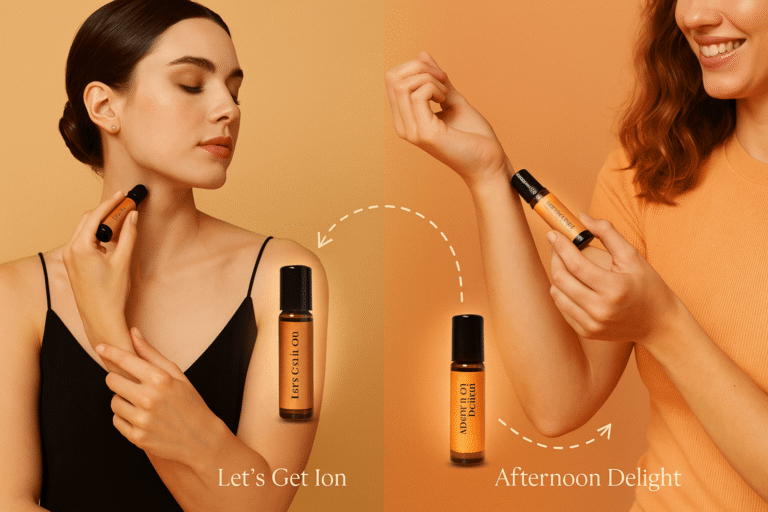
Apply to areas where your body generates heat: the inner wrists, sides of the neck, décolletage, behind the ears, and the inner elbows. The warmth from these areas encourages the oil to release its fragrance slowly and continuously. Avoid rubbing your wrists together after application, which can disrupt the molecular structure of more delicate top notes.
Start With Less Than You Think You Need
Perfume oils are concentrated. A single dab or roll at two or three pulse points is usually enough. Because the scent develops on the skin over time, the initial application may seem subtle, but it will deepen over the first hour of wear. Over-applying makes it harder to appreciate the layered quality that makes oil-based fragrance interesting.
Apply to Clean, Slightly Moisturised Skin
Fragrance anchors and lasts longer on moisturised skin. Applying after a shower, when skin is clean but still holds a little warmth and hydration, gives the oil an ideal base. If your skin is very dry, a light unscented body oil applied first can help the fragrance last longer and develop more evenly.
Consider Layering
Perfume oils pair well with complementary products from your existing routine. A matching or complementary mood mist over hair and clothing adds a different dimension to the scent: lighter, more diffuse, and with a slightly different evolution than the oil worn on skin.
When Natural Perfume Oils Are the Right Choice
Natural perfume oils are not a replacement for every fragrance situation, but they are particularly well suited to certain contexts and preferences.
They work well for people who find conventional spray perfumes overwhelming, either on themselves or on others. If you have ever had a headache from a crowded lift or found synthetic fragrances sit uncomfortably on your skin, an oil-based botanical fragrance is often a more tolerable and enjoyable alternative.
They also suit anyone who values a more personal scent experience, one that belongs to you rather than performing for others. The intimate projection and body-chemistry adaptation of perfume oils creates something that feels individual in a way that standardised sprays rarely do.
In practical terms, oil-based perfume is also well suited to the Australian climate. In heat and humidity, heavy spray fragrances can feel sharp or medicinal. A well-chosen perfume oil stays comfortable and wearable throughout the day without the scent turning on you in the afternoon heat.
And for anyone building a broader fragrance and wellbeing routine, oils integrate naturally alongside essential oil blends, mood mists, and aromatherapy practices in a way that spray perfumes generally do not.
A Softer, More Considered Way to Wear Fragrance
The benefits of natural perfume oils are not about rejecting synthetic fragrance outright. They are about understanding what makes oil-based, botanical fragrance a different and, for many people, more enjoyable experience.
The skin-warming intimacy. The gradual development. The scent that adapts to you rather than announcing itself on your behalf. These qualities make oil-based botanical fragrance genuinely distinct, not just as a cleaner ingredient choice, but as a different way of experiencing fragrance altogether.
Some people gravitate toward bright citrus and florals. Others find they settle most naturally into warmer musks, woods, and skin scents. Exploring different perfume oils is often the best way to discover what truly works with your own body chemistry, because until a fragrance meets your skin, you cannot fully know how it will develop. Browse the natural perfume oils range to find something worth making your own.
Frequently Asked Questions
Choosing a fragrance is deeply personal, and natural perfume oils often raise different questions than traditional spray perfumes. These answers explore how oil-based fragrance behaves on the skin, how to wear it effectively, and what makes the experience feel so different from conventional perfume.
What makes natural perfume oils different from regular perfume?
The main difference is the base. Conventional perfumes use alcohol to carry and project fragrance, which causes the scent to evaporate quickly and project outward. Natural perfume oils use a carrier oil base, which means the fragrance warms slowly with your body heat and releases gradually over time. This creates a more intimate, skin-close scent that develops throughout the day rather than fading after the first hour.
Do natural perfume oils last as long as spray perfumes?
Yes, though the experience of longevity is different. Spray perfumes tend to project strongly at first and then fade, so you notice the absence once it is gone. Natural perfume oils release slowly and consistently, often lasting six to eight hours on pulse points without needing to reapply. Because they stay close to the skin, you may notice the scent more in close moments and movement rather than as an ambient presence in the room.
Are natural perfume oils suitable for sensitive skin?
Generally, yes. Because they are alcohol-free and often formulated without the synthetic preservatives and fixatives common in mainstream fragrances, natural perfume oils tend to be gentler on skin. Many people who find spray perfumes drying or irritating tolerate oil-based alternatives without issue. That said, individual sensitivities vary, so a patch test before regular use is always sensible, particularly if you have known sensitivities to specific botanicals or essential oils.
Can I wear natural perfume oils in a professional setting?
Natural perfume oils are well suited to professional environments because they stay close to the skin rather than projecting outward. This makes them less likely to overwhelm colleagues in shared spaces, meeting rooms, or open-plan offices. The scent is usually noticeable in close conversation rather than from across the desk, which tends to be a more appropriate level of fragrance at work.
How do I layer natural perfume oils with other products?
Perfume oils layer well because their close-to-skin projection does not compete aggressively with other scents. A simple approach is to start with a lightly scented or unscented body oil to moisturise and prime the skin, apply the perfume oil to pulse points, then finish with a complementary mood mist over hair and clothing for a soft ambient layer. Choose complementary scent families, such as florals with light musks or citrus with clean woody notes, so the result feels cohesive rather than crowded.
Why does the same perfume oil smell different on different people?
Oil-based fragrances interact directly with your skin, so factors like your skin’s natural pH, the oils your skin produces, and your body temperature can all influence how the fragrance develops. The result is that the same perfume oil may smell subtly different from person to person. This is part of what makes oil-based fragrance feel personal rather than generic.