What Does Cruelty-Free Mean in Cosmetics and Body Care?
What does cruelty-free mean when you see it on cosmetics, body oils or other personal-care products? Generally, it means that the product has been developed without testing on animals. However, the words alone may not explain whether the claim covers only the finished product or also its ingredients, suppliers and testing conducted by third parties.
Cruelty-free is also commonly confused with vegan, natural and organic. These terms describe different qualities, and none automatically guarantees the others. Understanding the distinction can help you look beyond the label and choose products that genuinely align with your values.
In simple terms: cruelty-free concerns animal testing. Vegan concerns animal-derived ingredients. Natural and organic describe aspects of ingredients or production. A product may meet one of these descriptions without meeting the others.
What Does Cruelty-Free Mean?
Cruelty-free generally describes a product developed without animal testing. In cosmetics and personal care, animal testing may relate to the safety of a finished formula or the individual ingredients used to create it.
The difficulty is that a short cruelty-free statement does not always reveal the complete scope of a brand’s policy. One company may be referring only to its finished products, while another may also consider ingredient testing, suppliers, commissioned tests and the practices of third parties.
This is why a clear animal-testing policy can be more informative than a cruelty-free phrase or rabbit image displayed on its own.
What Makes a Cosmetic or Body-Care Product Cruelty-Free?
A meaningful cruelty-free policy should consider more than whether the brand physically tests the finished bottle or jar itself. Depending on the standard being used, it may consider:
- whether the finished product is tested on animals;
- whether individual ingredients are currently tested on animals;
- whether the brand commissions another organisation to perform animal testing;
- whether relevant suppliers conduct or commission testing for the supplied ingredients; and
- whether animal testing is undertaken by a third party in connection with selling the product.
A useful distinction
Saying that a brand does not personally test its finished products is narrower than having a policy that also considers ingredients, suppliers and third-party testing.
Absolute statements such as “this ingredient has never been tested on animals anywhere” can be difficult to substantiate. Many cosmetic ingredients have long histories extending beyond the brand currently using them. A responsible modern cruelty-free claim is therefore usually based on current development, sourcing and testing policies rather than claiming knowledge of every historical use of an ingredient.
Is Cruelty-Free the Same as “Not Tested on Animals”?
The phrases are often used to express a similar idea, but the precise wording matters.
A statement such as “finished product not tested on animals” only tells you about the final formula. It does not necessarily explain the testing position of the ingredients or suppliers. A broader cruelty-free policy may address all of these stages.
This does not mean that every uncertified claim is misleading. It means shoppers should read what the brand actually promises instead of assuming that every cruelty-free statement follows an identical standard.
Cruelty-Free vs Vegan: What Is the Difference?
Cruelty-free and vegan are related ethical considerations, but they answer different questions. Cruelty-free concerns testing, while vegan concerns ingredients.
| Claim | What it generally describes | What it does not automatically guarantee |
|---|---|---|
| Cruelty-free | Animal-testing practices | That the formula contains no animal-derived ingredients |
| Vegan | No intentionally included animal-derived ingredients | That no animal testing occurred |
| Natural | Ingredients derived from natural sources, according to the meaning used by the brand | That the product is vegan, organic or cruelty-free |
| Organic | How qualifying agricultural ingredients were produced | That the complete formula is vegan or cruelty-free |
Can a Product Contain Animal-Derived Ingredients and Still Be Cruelty-Free?
Yes. Under the meaning commonly used in the beauty and personal-care industry, a product may contain animal-derived ingredients and still be described as cruelty-free. This is because cruelty-free generally refers to animal-testing practices, rather than where every ingredient originated.
For example, a product containing beeswax, honey, lanolin or carmine could potentially be considered cruelty-free if the brand’s animal-testing requirements are met. However, that same product would not be considered vegan because it contains an ingredient obtained from an animal.
Cruelty-free and vegan answer different questions
- Cruelty-free: Was the product—or its ingredients—tested on animals under the standard being used?
- Vegan: Does the formula contain ingredients or by-products derived from animals?
A product can therefore be cruelty-free without being vegan, vegan without having a sufficiently verified cruelty-free testing policy, both, or neither.
Some shoppers understandably use the idea of cruelty-free more broadly and feel that using animal-derived ingredients is inconsistent with avoiding harm to animals. That is why it is worth checking both claims separately rather than assuming that one automatically includes the other.
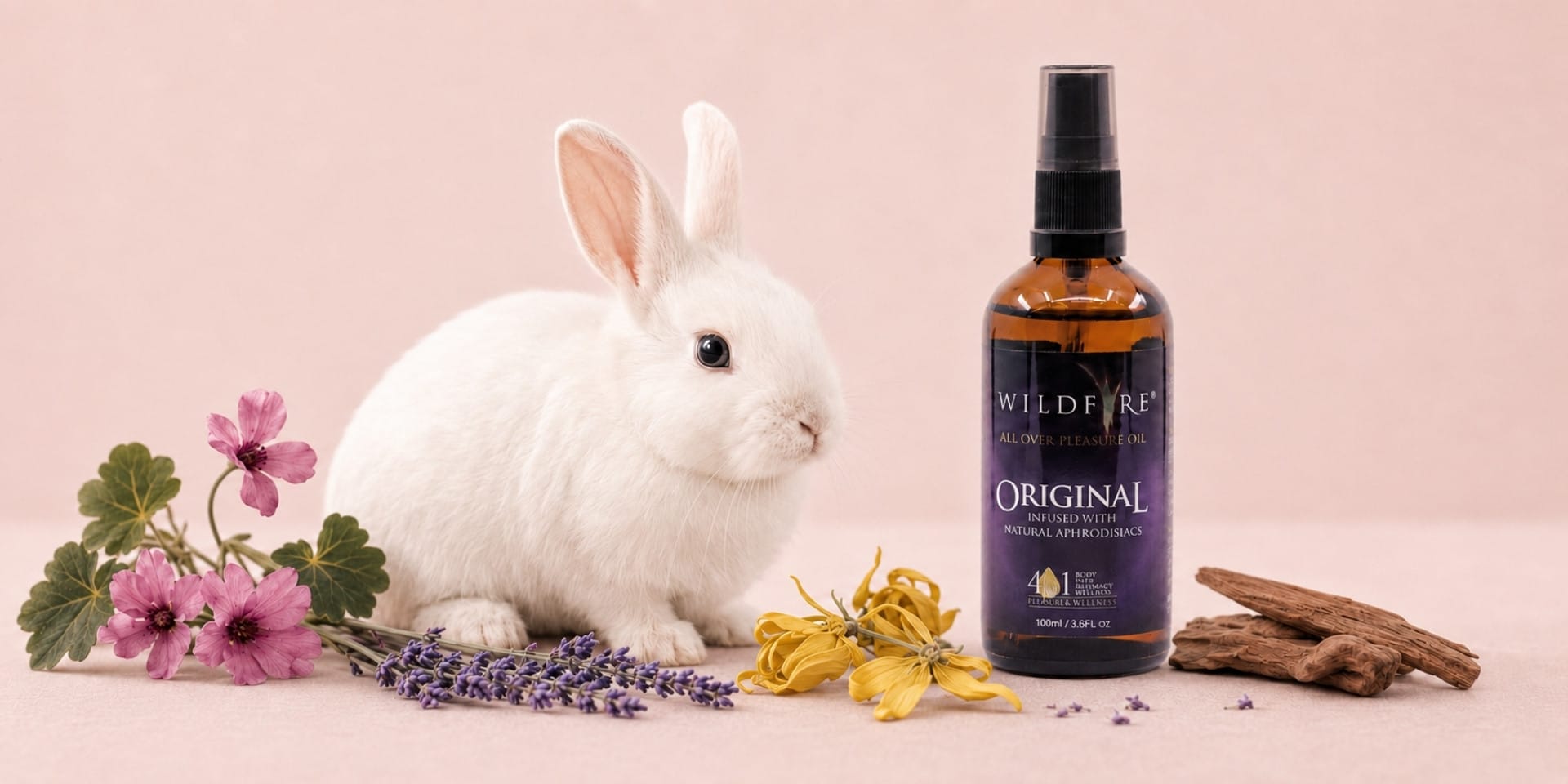
Wildfire body and massage oils are both cruelty-free and vegan-friendly, so they are made without animal testing and without animal-derived ingredients. Products from other brands should be assessed according to the individual cruelty-free and vegan information provided for that range.
Are Cruelty-Free Cosmetics Better for Your Skin?
Not automatically. Cruelty-free describes animal-testing practices; it does not determine whether a formula will suit a particular person’s skin.
A cruelty-free product is not necessarily:
- natural or organic;
- free from synthetic ingredients;
- hypoallergenic;
- suited to sensitive skin;
- environmentally sustainable; or
- more effective than another formula.
Likewise, an ingredient with a scientific or unfamiliar name is not automatically harsh or unsafe. Natural ingredients can also cause irritation or sensitivity for some people.
Choose products by considering both the ethical claim and the actual formula. Read the ingredient list, follow the product directions and consider a patch test when trying something new, particularly if you know your skin is sensitive.
Can a Product Be Cruelty-Free Without Certification?
Yes. A company can follow cruelty-free practices without participating in an independent certification program. Certification involves an external standard and application process, so the absence of a certification logo does not, by itself, prove that a product was tested on animals.
Certification can nevertheless give shoppers additional evidence. For example, the Cruelty Free International approval program requires approved brands to maintain a fixed cut-off date policy, monitor relevant suppliers and undergo independent auditing.
If a package displays a certification logo, check the certifying organisation’s official directory rather than relying on the image alone. This helps confirm that the approval is current and genuinely connected to the brand or product.
Search Cruelty Free International’s approved-brand directory
How Can You Tell If a Product Is Cruelty-Free?
If choosing cruelty-free cosmetics or body-care products matters to you, use the following checks before relying on a label:
- Read the exact claim. Look for an explanation rather than relying only on a rabbit symbol or the words “ethical beauty.”
- Check whether it covers more than the finished product. A fuller policy may also discuss ingredients, suppliers, commissioned testing and third parties.
- Do not substitute unrelated claims. Vegan, natural, clean and organic do not automatically mean cruelty-free.
- Verify certification. If the company displays an independent certification, look it up in the certifier’s official database.
- Read the brand’s animal-testing policy. Clear wording should help you understand what the company controls and what it asks of its suppliers.
- Ask when the wording is unclear. A responsible business should be able to explain the basis of its claim without disclosing commercially sensitive supplier identities or formulations.
You do not need to know every detail of a brand’s supply chain. You should, however, be able to understand what its cruelty-free statement covers.
What Should Australian Shoppers Know About Cosmetic Animal Testing?
Australia introduced restrictions on the use of new animal-test data for cosmetic ingredients from 1 July 2020. Under the Australian Industrial Chemicals Introduction Scheme, the restrictions apply when businesses categorise certain chemical introductions or apply for an assessment of a cosmetic ingredient.
In this context, “new animal test data” refers to data obtained from relevant animal tests conducted on or after 1 July 2020. Existing historical data may still be used, and limited exceptions apply in particular circumstances, including some chemicals with multiple uses.
It is therefore too broad to interpret the Australian rules as proof that every cosmetic sold in Australia automatically satisfies every cruelty-free standard. Shoppers should still consider the policy and evidence provided by the individual brand.
What Does Cruelty-Free Mean at Wildfire?
At Wildfire, our entire product range is cruelty-free. Products developed and made by Wildfire are created without animal testing, and we choose ingredients from suppliers whose stated practices align with our cruelty-free commitment.
The international fragrance brands we distribute, including Pure Instinct and Simply Sexy, also state that their products are cruelty-free. These are imported brands rather than products formulated or manufactured by Wildfire.
We also believe it is important not to blur cruelty-free with other product qualities. Wildfire body and massage oils are vegan-friendly as well as cruelty-free, but these remain two separate commitments: one concerns animal-testing practices and the other concerns the ingredients used in the formula.
Our approach is centred on thoughtfully selected products for body care, fragrance, massage and connection, without compromising our cruelty-free commitment.
Explore Wildfire’s cruelty-free range
Discover cruelty-free body and massage oils, essential oil blends, mood mists, intimate-care products and pheromone fragrances.
Frequently Asked Questions
Find clear answers to common questions about cruelty-free labelling, animal-derived ingredients, vegan products and how Wildfire approaches its cruelty-free commitment.
What does cruelty-free actually mean?
Cruelty-free generally means that a product was developed without animal testing. Because the scope of individual claims can vary, check whether the brand’s policy addresses the finished product, ingredients, suppliers and testing commissioned from third parties.
Is cruelty-free the same as vegan?
No. Cruelty-free concerns animal testing, while vegan concerns animal-derived ingredients. A product can be cruelty-free without being vegan, vegan without satisfying a particular cruelty-free standard, or both vegan and cruelty-free.
Does cruelty-free mean the ingredients were never tested on animals?
Not necessarily in the absolute historical sense. Many established cosmetic ingredients have long histories. A modern cruelty-free policy normally focuses on whether animal testing is currently conducted, commissioned or permitted within the relevant product and supply chain.
Can cosmetics be cruelty-free without certification?
Yes. Independent certification provides verification against a particular standard, but a company may follow cruelty-free practices without being certified. The brand should still be able to explain the basis and scope of its claim.
Are cruelty-free cosmetics natural or better for sensitive skin?
Not automatically. Cruelty-free describes animal-testing practices, not whether a formula is natural, organic, hypoallergenic or appropriate for a particular skin type. Assess the ingredient list and product directions separately.