
In this issue
Desire · Attention · Connection
I Don’t Feel Desired by My Partner
Why you can feel deeply loved and still miss the feeling of being wanted.

There is a particular kind of loneliness that can exist inside an otherwise loving relationship.
Your partner might kiss you goodbye in the morning. They might ask how your day was, remember how you take your coffee, pick something up from the shops because they know you need it, sit beside you on the sofa at night and tell you they love you.
You believe them.
And yet, somewhere underneath all of that care, there can be another thought that is much harder to admit:
I know you love me. I just don’t feel like you want me anymore.
That distinction matters.
Because sometimes what is missing from a relationship isn’t love at all.
It’s the feeling of being desired.
The Meaningful Conversation
Loved. Attractive. Desired.
We often talk about these things as though they are interchangeable.
They aren’t.
Love can say: I care about you. I’m committed to you. You’re important to me.
Attraction can say: I still find you beautiful, handsome, appealing or compelling.
But expressed desire says something slightly different:
I notice you.
I reach for you.
I want to be close to you.
I choose you, and I let you see me choosing you.
A relationship can contain enormous amounts of the first, and perhaps even the second, while becoming strangely quiet around the third.
That is why hearing “Of course I still find you attractive” doesn’t always resolve the ache.
The reassurance may be completely genuine.
But perhaps attraction was never really the question.
Perhaps what you were trying to ask was:
Why don’t I experience you wanting me anymore?
Desire has a language
Think back to the beginning of a relationship.
Desire rarely needed an announcement.
It lived in the look held for a second too long.
The message sent for no particular reason.
Sitting closer than necessary.
A hand finding another hand.
The compliment that didn’t sound automatic.
The kiss that wasn’t simply hello or goodbye.
The sense that, in a room containing everybody else, one person was particularly aware of you.
Over time, those signals can become quieter.
Not necessarily because attraction has disappeared, but because life has become louder.
Work. Children. Money. Exhaustion. Phones. Household jobs. Familiarity. Stress. Different bedtimes. Different levels of desire. Years of knowing that the other person will probably still be there tomorrow.
Love can become incredibly efficient.
Did you pay that bill?
What time are you home?
Can you grab milk?
Don’t forget Saturday.
All signs of a shared life.
Just not necessarily signs of desire.
And sometimes nobody notices the difference until one person begins to feel its absence.
What are you actually missing?
“I don’t feel desired” sounds like one feeling.
It can mean many different things.
Maybe you miss your partner initiating.
Maybe they never flirt with you anymore.
Perhaps you’re always the one reaching for their hand, beginning the kiss or suggesting time together.
Maybe you have sex, but you still don’t feel pursued.
Maybe affection exists, but it feels companionable rather than charged.
Perhaps what you miss isn’t sex at all.
It’s being noticed.
A look across the kitchen.
A hand at your waist as they pass.
A specific compliment.
Being pulled closer.
Hearing “You look incredible tonight” rather than having to ask, “Do I look okay?”
This is worth understanding before deciding what the problem is.
Because “I need more sex” and “I need to feel wanted” aren’t necessarily the same request.
And trying to solve the wrong one can leave both people frustrated.
For some couples, what feels like a loss of desire is also connected to a broader loss of everyday touch. Our guide to touch deprivation explores what can happen when ordinary physical affection becomes scarce.
Being loved is knowing you matter. Feeling desired is experiencing someone showing you that you matter.
This isn’t only something women need
There is an old relationship script that casts one partner as the pursuer and the other as the person being pursued.
Real relationships are considerably more complicated.
In a 2021 study, Sarah Hunter Murray and Lori Brotto explored the experiences of 300 heterosexual men in intimate relationships. The vast majority described feeling desired by their partner as important to their sexual experiences.1
The signals they described were not confined to sex. They included verbal expressions of desire, flirting, romantic and non-sexual touch, their partner initiating and enthusiastic participation.1
That matters because it challenges the idea that wanting to feel wanted is somehow a particularly feminine need.
Sometimes the person who appears confident, initiates most often or seems to need less reassurance may quietly be wondering whether they would ever be pursued if they stopped doing the pursuing.
“But we’re still having sex.”
This is where things become more complicated.
A couple can have sex and one person can still feel unwanted.
Because frequency doesn’t necessarily answer the emotional question.
If one person nearly always initiates, while the other usually agrees but seldom expresses desire independently, the relationship may be sexually active while one partner still wonders:
Would this happen if I didn’t start it?
That doesn’t automatically mean the other person isn’t attracted to them.
Desire can be affected by stress, exhaustion, relationship dynamics, differences in libido and many other circumstances. People also experience and express desire differently.
But neither should the uncomfortable feeling simply be dismissed because sex is technically still happening.
Sometimes the missing ingredient isn’t intercourse.
It’s reciprocity.
The experience of occasionally being the person somebody else reaches for first.
If I have to ask for it, doesn’t that make it fake?
Perhaps this is the hardest part.
Because once you’ve had to say:
“I want you to make me feel wanted,”
anything that follows can feel suspicious.
They compliment you.
They’re only saying that because I asked.
They initiate.
They’re doing it because we had that conversation.
They reach for you.
Would they have done that otherwise?
It can become an impossible test because the very conversation intended to improve connection becomes evidence against every attempt to reconnect.
There is another way to think about it.
You aren’t asking your partner to manufacture desire. You’re telling them how you recognise it.
Those are very different things.
Consider:
“You need to initiate sex twice a week so I know you still fancy me.”
versus:
“I’ve realised that when you’re the one who reaches for me first, I feel really wanted.”
The first prescribes a performance.
The second reveals something about you.
We teach the people we love how we experience love all the time.
We tell them which birthdays matter, what comforts us when we’re upset, whether we’d rather talk immediately after an argument or have some space, and what makes us feel appreciated.
Explaining how desire reaches you doesn’t automatically make the response artificial.
It gives your partner information they may never have understood.
Don’t just ask, “Do you still find me attractive?”
It’s an understandable question.
Unfortunately, it can also be a conversational dead end.
“Of course I do.”
Now what?
You’ve received reassurance, but nothing about the relationship necessarily changes.
A more vulnerable and more useful conversation might sound like:
“I’ve realised I miss feeling pursued by you. I feel especially wanted when you reach for me first, flirt with me or show me you’re excited to be close to me. What makes you feel wanted by me?”
That last question changes everything.
Because this isn’t necessarily a conversation about what your partner is failing to give you.
It can become a conversation about how both of you experience desire.
You might discover they have been missing something too.
Make desire smaller
When a relationship feels disconnected, the temptation is to prescribe something dramatic.
A romantic weekend.
More date nights.
More sex.
A complete reinvention of the relationship.
But desire doesn’t always need a grand gesture.
Sometimes it needs somewhere small to exist again.
A kiss that lasts longer than the habitual goodbye.
Sitting together without a phone between you.
A compliment that is specific enough to feel noticed.
Flirting without needing it to lead anywhere.
Touch that carries no obligation.
Trying somewhere new together.
Reaching for your partner because you want to, rather than because you’re beginning a sequence with an expected ending.
This last one may be particularly important.
Not every expression of desire has to become a request for sex.
When every lingering kiss, massage or affectionate touch is interpreted as initiation, couples can begin avoiding those things when they don’t want sex.
Gradually, an enormous amount of physical connection can disappear with them.
Allowing touch to simply be touch sometimes can create more room for affection, playfulness and closeness to return without pressure.
If that distinction feels particularly relevant, our guides to physical touch in relationships and physical intimacy without sex explore ways closeness can exist without every gesture needing to lead somewhere.
Not every kiss needs a sequel. Not every touch needs an intention. Sometimes closeness is enough.
What if nothing changes?
This deserves an honest answer.
Talking about a need doesn’t guarantee that another person can — or wants to — meet it.
But their response tells you something.
A partner who responds with curiosity and wants to understand what you’re experiencing is giving you different information from one who repeatedly mocks, dismisses or refuses to discuss something that matters deeply to you.
Likewise, discovering that your partner experiences desire very differently isn’t proof that either person is defective.
It may mean the conversation needs to become deeper.
What does intimacy mean to each of you?
What feels authentic?
What feels pressured?
What has changed?
What can genuinely be rebuilt, and what can’t?
Those questions are harder than a list of relationship hacks.
They’re also more useful.
Because the goal isn’t to persuade someone to perform desire convincingly enough that you stop noticing its absence.
It’s to understand whether the two of you can create a relationship in which both people can feel chosen without either person having to pretend.
Perhaps the spark isn’t one thing
We often describe long relationships as having either kept the spark or lost it.
As though desire were a pilot light that mysteriously extinguishes one night.
Real life is rarely that neat.
Sometimes the spark is still there, but the signals have disappeared.
Sometimes affection has become so familiar that nobody thinks to express attraction aloud.
Sometimes one person has stopped initiating after years of feeling rejected.
Sometimes life has consumed the space where playfulness used to live.
And yes, sometimes desire itself has changed.
The answer isn’t always reassurance.
It’s curiosity.
What exactly am I missing?
What makes me feel desired?
What makes you feel desired?
When did we stop doing those things?
Do we both want to find our way back to them?
Because after years together, perhaps desire isn’t only something you either spontaneously feel or don’t.
Sometimes it’s something you make room to show.
For couples who both want to rebuild that space, our guide to bringing the spark back into a relationship looks more broadly at reconnection, novelty and intimacy.
You can know that somebody loves you.
You can know they chose you.
But every now and then, it can still mean everything to feel them choosing you again.
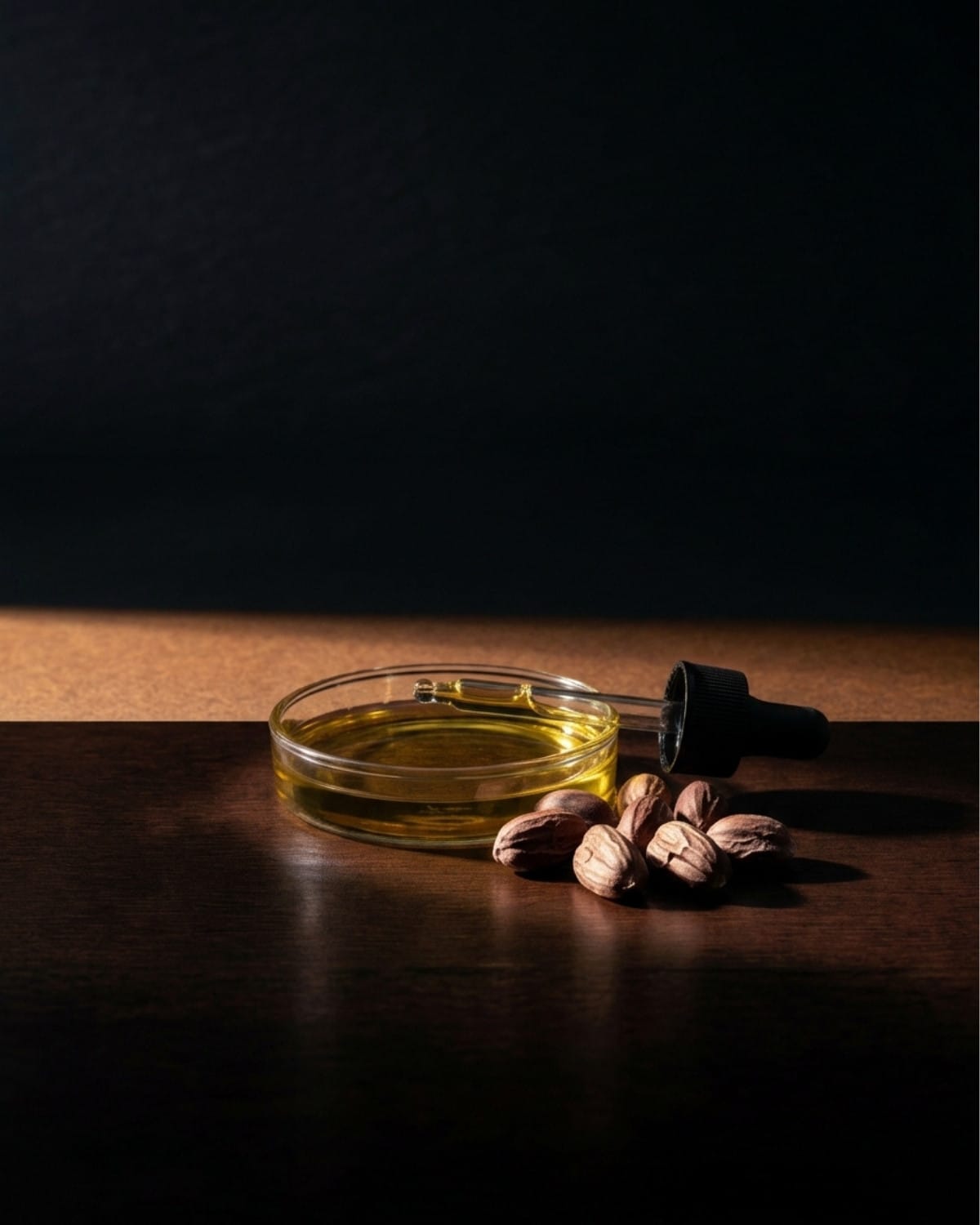
The Sacred Ingredient
Jojoba
The oil that isn’t really an oil.
Some ingredients earn their place through fragrance. Others through the way they transform a formula. Jojoba is quieter than that.
Despite the familiar name “jojoba oil”, jojoba is technically a liquid wax produced from the seeds of Simmondsia chinensis. Unlike conventional vegetable oils built primarily from triglycerides, jojoba consists predominantly of long-chain wax esters.2
That unusual composition contributes to its useful stability and emollient character, helping explain why jojoba appears in many personal-care cosmetic formulations.2
There is also something fitting about choosing jojoba for an issue devoted to touch.
Touch is easy to think of as a means to an end.
A massage relaxes tired muscles.
A kiss leads somewhere.
A hand wandering across skin signals what comes next.
Except sometimes, nothing needs to come next.
Massage can simply be an opportunity to slow down and pay attention to another person: the warmth of their skin, where they hold tension, how they respond to pressure and the simple experience of giving someone your undivided attention.
Jojoba is one of the ingredients Wildfire uses within its pleasure-oil formulations, where it forms part of a broader blend designed around glide, skin feel and the sensory experience of massage.
If you’re curious about the ingredient itself, our guide to jojoba oil and intimate touch explores where a simple carrier oil can be useful and where a finished formulation may make more sense.
And in an issue about feeling desired, perhaps that is worth remembering.
Sometimes being touched with attention can say something words struggle to express:
I’m here.
I’m noticing you.
A Ritual
Ten Minutes With Nowhere to Go
This isn’t foreplay. That’s important.
Choose ten minutes when neither of you needs to rush anywhere.
01
Remove the destination
Agree before you begin that nothing has to happen afterwards. This is not a promise of sex or the beginning of a sequence. It is simply time together.
02
Give one another your attention
Put the phones away. Lower the lights if you like. Add music or a favourite scent, or don’t. Take turns giving each other unhurried touch.
It could be a shoulder massage. Hands through hair. A back rub. Holding one another. Sitting close enough that you can feel the other person’s warmth.
03
Let closeness be enough
Notice what happens when neither person has to interpret touch as a request for something more. There is no obligation to perform a particular response and no need to manufacture a romantic moment.
The ritual is attention, not escalation.
When touch is allowed to have no destination, it can become easier to enjoy again.
If you would like a little more structure, our sensual massage guide explores ways couples can create slower, more intentional time for touch.

A Conversation Starter
What makes you feel wanted by me?
Not:
“Do you still want me?”
That question almost demands reassurance.
Try something more curious instead.
“What do I do that makes you feel wanted?”
Then listen.
Their answer may surprise you.
Perhaps it’s when you initiate affection.
When you compliment them unexpectedly.
When you put your phone down while they’re speaking.
When you reach for their hand.
When you kiss them properly rather than automatically.
When you make time for the two of you.
Then answer it yourself.
Try to describe behaviours rather than deficiencies.
“I feel wanted when you…”
rather than:
“You never…”
You’re not compiling a performance checklist for each other.
You’re learning each other’s language.
Desire doesn’t always disappear dramatically. Sometimes we simply stop showing each other that it’s there.
A Gentle Invitation
Create room to notice each other
Sometimes connection doesn’t need another task added to the relationship.
It needs fewer distractions.
An unhurried massage. A shared bath. Music after dinner. A familiar scent. Twenty minutes together after everyone else has gone to bed.
Wildfire is made for moments like these: sensory products designed to become part of touch, mood and connection without dictating what that connection has to become.
Explore Wildfire Pleasure Oils for massage, body care and slower shared rituals.
Explore the ritualSometimes creating space for connection begins simply by giving each other enough time to be noticed.
A Thought to Carry With You
There is something beautiful about being chosen at the beginning of a relationship.
The first message.
The first kiss.
The first I love you.
The moment two separate lives begin becoming one.
But long relationships contain another kind of choosing.
It happens after familiarity.
After you’ve seen each other exhausted, distracted, grumpy and ordinary.
After bills and laundry and school runs and difficult weeks.
After you’ve stopped wondering whether this person will call tomorrow because, of course, they’ll be there.
Perhaps that’s why small expressions of desire can matter so much later.
They quietly interrupt the familiarity and say:
I haven’t stopped seeing you.
You don’t need to recreate the beginning.
You don’t need to perform passion.
And you don’t need every evening together to become an occasion.
Sometimes you just need to look across the life you’ve built together and remind the person beside you:
I’d still choose you.
And sometimes, you need to feel them say it back.