
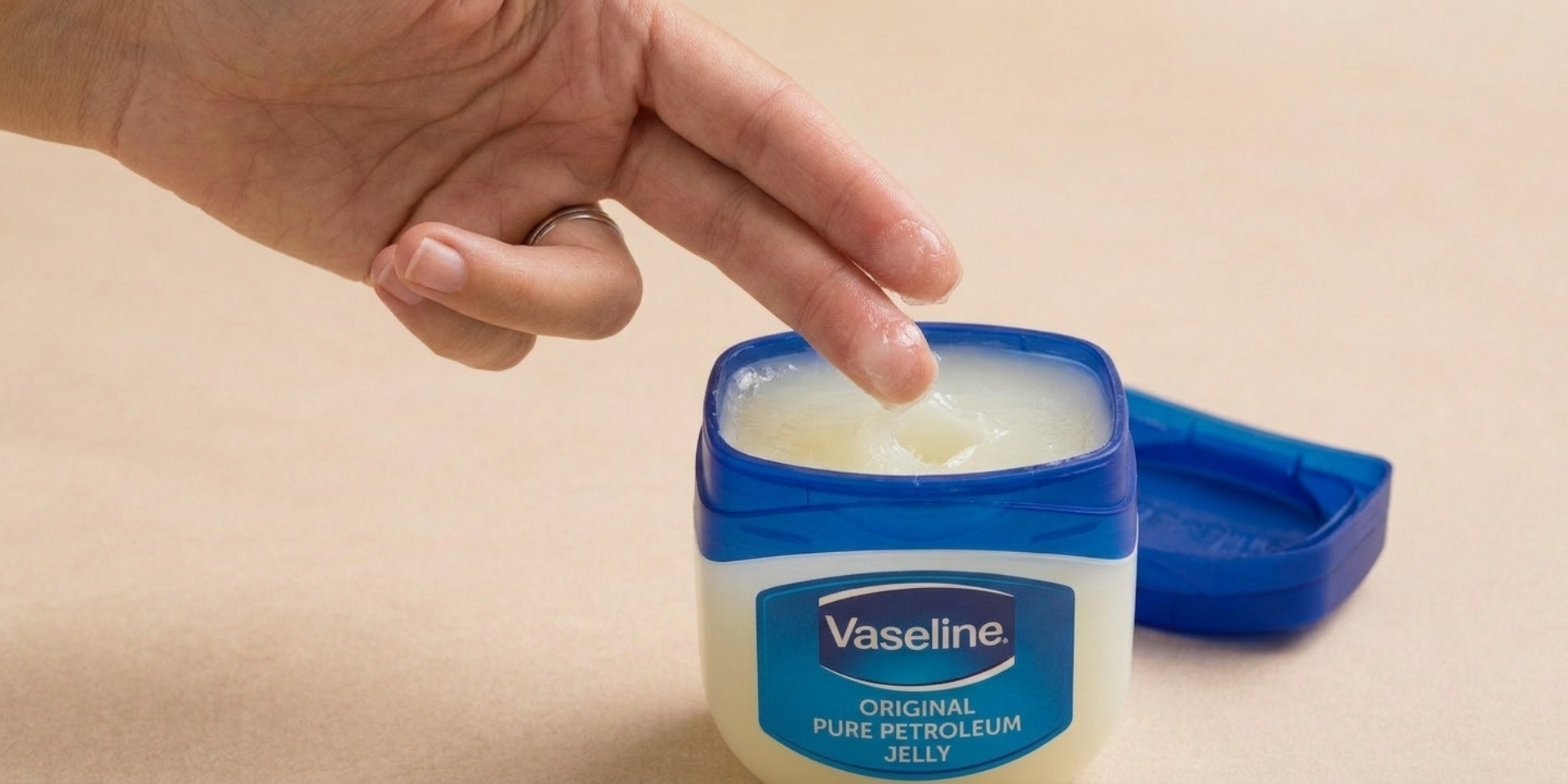
Can Vaseline Be Used as Lube?
If you have a tub of Vaseline nearby and no personal lubricant on hand, it is easy to see why you might wonder whether it can do the same job. It is smooth, slippery and stays on the skin for a long time.
But the question is not simply whether Vaseline can reduce friction. It is whether petroleum jelly is a good choice for intimate use.
The direct answer
Vaseline can feel slippery enough to work as lube, but it is not designed as a personal lubricant and we would not choose it for vaginal or anal sex. Petroleum jelly is oil-based, can weaken latex condoms, can be difficult to wash away, and research has found an association between intravaginal petroleum jelly use and bacterial vaginosis.
It feels slippery. So why isn’t that enough?
The appeal of Vaseline makes complete sense. It does not disappear quickly, it creates a smooth barrier over the skin and most people already know what it feels like.
Those qualities are useful for what petroleum jelly was actually made to do. Vaseline Australia describes its petroleum jelly as a skin product that protects and locks in moisture, with petrolatum listed as the ingredient.
That is different from a product being formulated specifically for sexual lubrication. Something can be excellent at protecting dry skin without automatically being the right choice for vaginal or anal use.
Vaseline isn’t water-based or silicone-based
This is another common source of confusion. Vaseline is petroleum jelly. It is made from petrolatum and is considered an oil-based product, not a water-based or silicone-based personal lubricant.
That distinction matters because different lubricant bases behave differently. Water-based products tend to rinse away more easily, while petroleum jelly creates a more persistent barrier on the skin.
It also matters when condoms or other barriers are involved, because compatibility depends on both the lubricant and the material the barrier is made from.
It worked for me before. So why do people say not to use it?
You may have used Vaseline during sex before and experienced no obvious problem. That does not make your experience unusual, and using something once without irritation does not mean that harm is inevitable the next time.
The more useful question is whether there are enough drawbacks to make another product a better choice when you have the option.
It can stay around longer than you want
One of Vaseline’s strengths as a skin protectant becomes a disadvantage here. Petroleum jelly is designed to stay on the skin and resist being easily washed away.
That can mean more residue on skin after intimacy, more effort during clean-up and greasy marks on sheets or clothing. If what you want is smooth glide without a lingering heavy coating, that staying power may not be a benefit.
Intravaginal use has been associated with bacterial vaginosis
A 2013 study involving 141 women found that participants who reported using petroleum jelly inside the vagina during the previous month were 2.2 times more likely to test positive for bacterial vaginosis.
That finding shows an association. It does not prove that petroleum jelly directly caused bacterial vaginosis, and it should not be interpreted as meaning everyone who uses Vaseline will develop an infection.
It does, however, give us a good reason not to treat petroleum jelly as interchangeable with a product intended for intimate lubrication.
Latex condoms are a clear compatibility problem
If you use latex condoms, this part is much simpler. Petroleum jelly should not be used as the lubricant.
Healthdirect specifically advises against using oil-based lubricants such as petroleum jelly with latex condoms, because they can make the condom more likely to break.
If you are using condoms or contraceptive barriers, check product compatibility before use.
What if you’re not using condoms?
This is a reasonable follow-up. If latex condoms are not part of the situation, then the latex compatibility problem is no longer relevant.
But that does not automatically make Vaseline an ideal personal lubricant.
It is still a petroleum-based skin protectant rather than a purpose-made personal lubricant. It can still feel heavy, leave persistent residue, be awkward to clean from fabrics, and the research around intravaginal petroleum jelly use still applies regardless of whether a condom is involved.
So while “I’m not using condoms” changes one part of the decision, it does not answer the whole question.
What if you only use Vaseline externally?
Using petroleum jelly on ordinary external skin is not the same thing as using it as a sexual lubricant.
Vaseline is widely used to protect and moisturise dry skin, which is the type of use it is sold for. That does not mean it should automatically be treated as suitable for every part of the body or every type of intimate activity.
If you are thinking about applying it to external genital skin because of ongoing dryness, itching, burning or irritation, it is worth separating that concern from the question of lubrication. Persistent intimate discomfort can have many causes, so treating the symptom with whatever moisturiser happens to be nearby may not address what is happening.
For sexual activity, we would still choose something intended for the type of intimate contact you have in mind.
So what should you choose instead of Vaseline?
If you want lubrication specifically for intercourse, the clearest option is a personal lubricant made for that purpose and compatible with any condoms, barriers or toys you plan to use.
If the real reason you are considering Vaseline is that you have run out of lube or want to know what else might already be available, we have covered that question separately in our guide to lube alternatives and what to know before using them.
If your preference is specifically for plant-based oils rather than petroleum jelly, see our guide to natural lube alternatives. It explains how different oils behave and why an option that feels natural is not automatically suitable for every situation.
Prefer an oil made with intimate touch in mind?
Wildfire Pleasure Oils are formulated for body, massage, bath and intimacy, giving you an oil-based option designed around skin feel, glide and connected touch rather than adapting a household skin product for another job.
If you are using condoms or contraceptive barriers, check product compatibility before use.
Questions people ask about Vaseline and lube
Can petroleum jelly be used as lube?
Petroleum jelly can reduce friction because it is thick and slippery, but that does not make it an ideal personal lubricant. Vaseline is a petroleum-based skin protectant rather than a purpose-made sexual lubricant, and there are better choices for vaginal or anal sex.
Is Vaseline water-based or silicone-based?
Neither. Vaseline is petroleum jelly and is considered oil-based. Its ingredient is petrolatum. This is important when considering clean-up and compatibility with condoms or other barriers.
Can Vaseline be used as lube without condoms?
Not using latex condoms removes one of the major compatibility concerns, but it does not turn petroleum jelly into a purpose-made personal lubricant. Its persistent residue, clean-up and the association between intravaginal petroleum jelly use and bacterial vaginosis are still worth considering.
Does Vaseline actually work as lube?
It can create slipperiness and reduce friction, which is why people consider it. The problem is not whether it feels slippery. The issue is whether it is a good product to choose for intimate lubrication when more suitable options are available.
Can Vaseline be used as a personal lubricant for women?
We would not recommend choosing Vaseline as a vaginal lubricant. A study of intravaginal product use found an association between petroleum jelly use and bacterial vaginosis, and petroleum jelly is also incompatible with latex condoms. A personal lubricant intended for the type of intimate use you have in mind is the clearer choice.
Is Vaseline safe to use on intimate areas?
Using petroleum jelly on external skin is a different question from using it internally or as sexual lubricant. Vaseline is made and sold as a skin protectant, but that does not mean it is the right product for every intimate use. If you have persistent dryness, itching, pain or irritation around intimate areas, seek advice about the underlying cause rather than relying on Vaseline as a treatment.
Can you use Vaseline with condoms?
Do not use petroleum jelly with latex condoms. Oil-based products can weaken latex and make condoms more likely to break. For other condom or barrier materials, check the manufacturer’s compatibility instructions before choosing a lubricant.
The simplest answer is to match the product to the job
Vaseline is useful for what it was designed to do: protect skin and lock in moisture. The fact that it is smooth and long-lasting explains why people have tried using it as lube, but slipperiness alone is not enough to make a product a good choice for intimate lubrication.
If you have the option, choose a product made for the kind of intimate contact you are planning. And if what brought you here was really the question, “I’ve run out of lube, so what else can I use?”, our lube alternatives guide is the better next step.