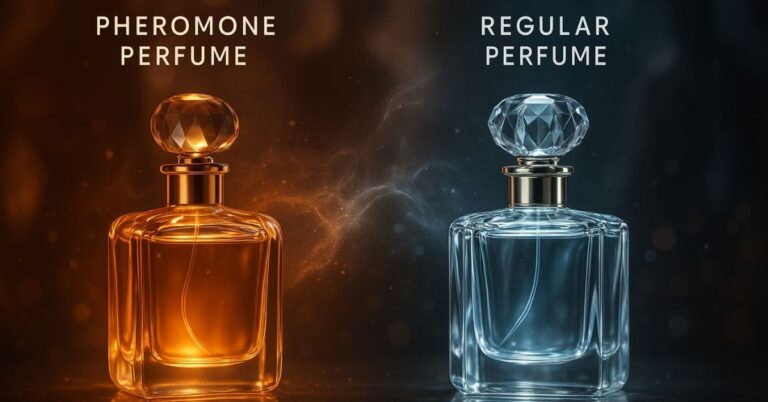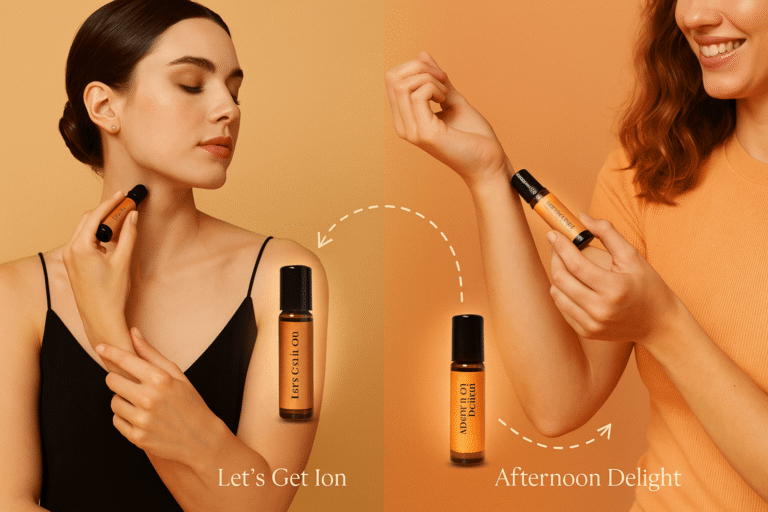
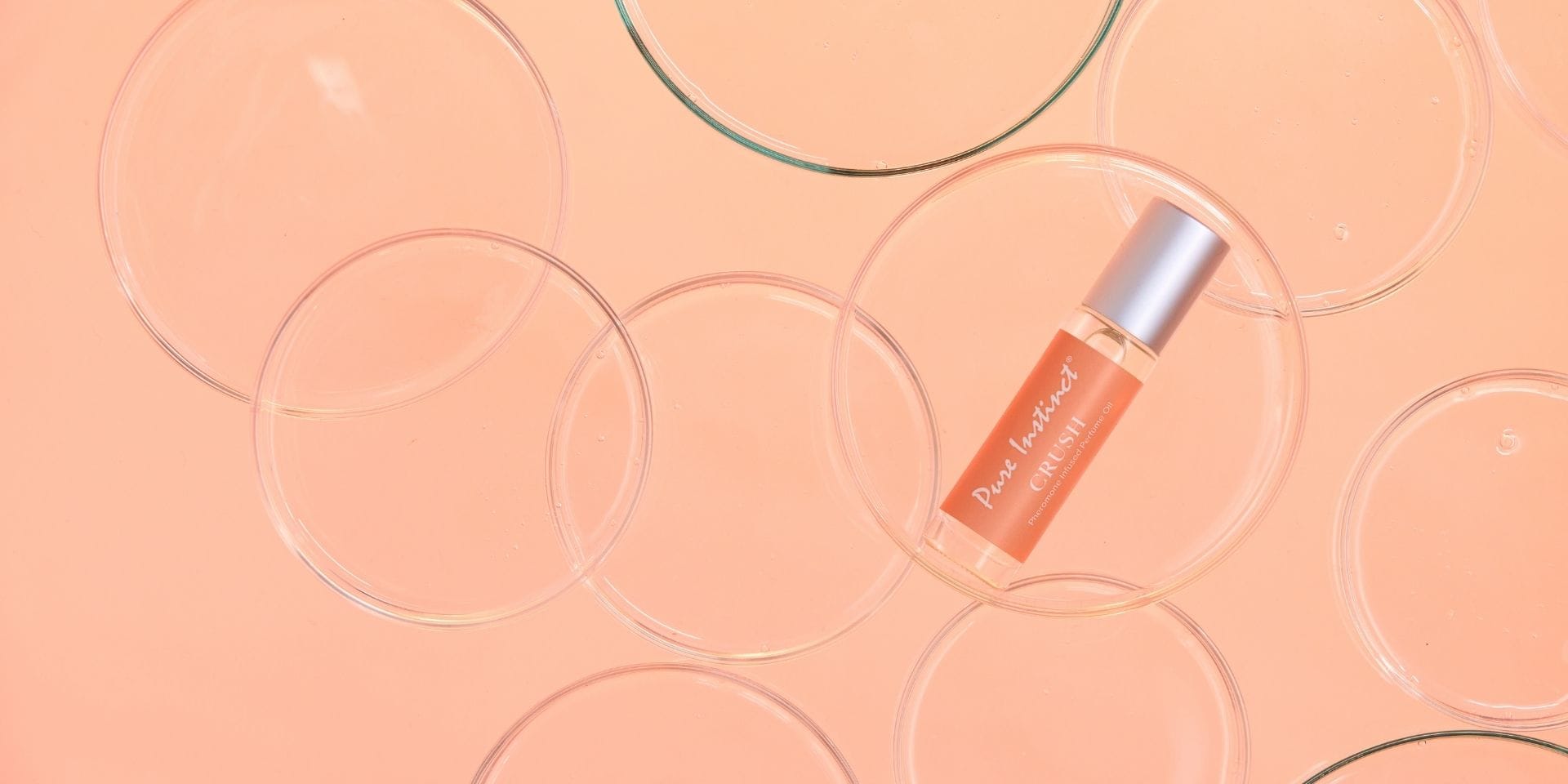
Does Pheromone Perfume Work? Science, Scent and Skin Chemistry
Pheromone perfume sits somewhere between fragrance, body chemistry and an evolving area of human scent research. The most useful answer is not a simple yes or no: perfume can interact with the person wearing it, scent can influence perception and confidence, and some candidate human chemosignals have produced measurable effects in studies, but attraction is never guaranteed.
Does pheromone perfume work? It can work on several levels, but not as a guaranteed attraction switch.
Fragrance itself is real sensory information. Research shows that perfume can combine with a person’s natural body odour to create an individually specific scent mixture, and pleasant fragrance can influence self-perception and the way people evaluate others. Separate research into compounds described as possible human chemosignals has produced some positive findings around mood, physiology and attractiveness, alongside other well-designed studies that found little or no effect.
That means the most accurate answer lives between two extremes. It would be too strong to say that a pheromone perfume can reliably make another person attracted to you. It would also be too simplistic to say that scent, body chemistry and social perception have nothing to do with one another.
Do pheromone perfumes really work?
Pheromone perfume can work as a personal fragrance experience, and there is credible evidence that scent, natural body odour and individual fragrance chemistry can affect how a perfume is perceived. Research also suggests that some compounds studied as possible human chemosignals can influence mood, attention, physiological responses or attractiveness under certain conditions.
What has not been established is that a commercial pheromone perfume will reliably trigger sexual attraction in another person. Results appear to depend on the fragrance, the wearer, the person smelling it, the social setting and the specific compounds involved. So it is better understood as a fragrance that may add another layer to scent and social perception, rather than a guaranteed biological shortcut to attraction.
Before Asking Whether Pheromone Perfume Works, Define “Work”
The phrase “does pheromone perfume work?” often bundles several different questions together. Separating them makes the evidence much easier to understand.
| What “working” could mean | What the evidence supports |
|---|---|
| The fragrance smells different on different people | Yes. Independent research shows meaningful interactions between perfume and individual body odour. |
| The scent changes how the wearer feels | Possible. Fragrance has been shown to affect self-perception, confidence and mood in controlled studies. |
| The scent changes how another person perceives the wearer | Possible. Olfactory information can influence social and attractiveness judgements. |
| A candidate chemosignal has a measurable psychological or physiological effect | Sometimes. Several studies report effects, while others report null results. |
| A commercial pheromone perfume reliably makes someone sexually attracted to the wearer | Not established. No commercial perfume has been shown to produce a dependable attraction response across people and situations. |
This distinction matters because a perfume can produce a very real personal or social effect without behaving like a pheromone in the strict biological sense.
Why the Same Perfume Can Smell Different on Different People
The idea that a fragrance becomes more individual once it meets the wearer is not simply perfume folklore.
In a 2012 series of experiments, researchers tested mixtures of perfume and natural body odour. They found significant interactions between the fragrance and the individual odour donor, concluding that perfume can create an individually specific odour mixture rather than merely covering the body’s existing smell.
There was another interesting finding. When participants’ natural body odour was paired with the perfume they had chosen for themselves, those mixtures were rated as more pleasant and attractive than mixtures made with a randomly assigned perfume, even when the perfumes alone were not rated differently.
A later study investigating fragrance and body-odour recognition also found that individual odour differences remained detectable when fragrance was worn, and that a person’s own fragrance preserved more of that individual quality than an assigned fragrance.
The useful takeaway
Perfume does not simply sit on every person in exactly the same way. The wearer’s natural odour, skin environment, temperature, fragrance choice and the way volatile ingredients evaporate can all contribute to the final scent that other people perceive.
This does not prove a pheromone effect. It does, however, give a strong scientific basis for the everyday observation that a fragrance can become distinctly personal on the skin.
Pure Instinct and the Idea of a Scent That Becomes Uniquely Yours
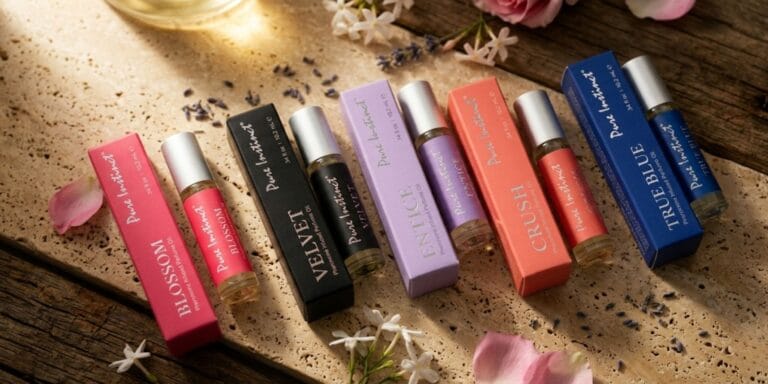
Pure Instinct builds much of its fragrance identity around this skin-level experience. The brand currently describes its Original roll-on as blending with the wearer’s natural chemistry to create a scent that is “uniquely yours”, and its wider range uses similar language around skin chemistry and personal scent development.
That claim should be understood in two separate parts.
What independent research supports
Fragrance can interact with natural body odour to create an individual scent mixture, and the same perfume may be perceived differently depending on who is wearing it.
What that research does not prove
The body-odour studies did not test Pure Instinct and did not show that added pheromone ingredients are the reason a fragrance becomes individual. Ordinary perfume-body odour interaction can already create wearer-specific differences.
Pure Instinct’s current Original roll-on ingredient list also identifies proprietary pheromone-style fragrance components in addition to its perfume composition. Those finished commercial ingredients should not automatically be treated as identical to individual research compounds such as androstadienone or androstenol.
That distinction is important. Scientific studies can help us understand the broader questions around scent and human chemical communication, but a study of one isolated molecule cannot be used as proof that an entire retail formulation will produce the same effect.
What Scientists Mean When They Use the Word Pheromone
In biology, a pheromone is more specific than “a smell that affects someone”. It is a chemical signal released by one member of a species that carries information to another member of the same species and produces a characteristic behavioural or physiological response.
Pheromones are firmly established in many animals. Human chemical communication is harder to map. Humans clearly produce complex body odours, people can distinguish individuals by scent, and body odour can carry socially relevant information. The unresolved question is whether particular molecules meet the strict biological criteria required to call them human pheromones.
Compounds including androstadienone, androstenol, androstenone and estratetraenol have all been investigated. Researchers often describe them more cautiously as putative pheromones, candidate chemosignals or simply odorous steroids because their exact biological status remains disputed.
If you want the category explained from the beginning, our guide to what pheromone perfume is separates the fragrance product from the biological definition.
What Research Has Found When Candidate Human Chemosignals Are Tested
The scientific record is more interesting than either “pheromones definitely work” or “nothing has ever been found”.
Androstadienone and speed-dating attraction
A 2008 study took androstadienone out of a simple laboratory face-rating task and into speed dating. Women exposed to the compound rated men as more attractive in two of three experiments. The authors argued that social context may be particularly important when studying chemosensory effects.
Androstadienone and emotionally relevant faces and voices
A 2016 study reported that androstadienone increased perceived attractiveness for emotionally relevant facial and vocal stimuli. Importantly, the effect did not follow the simple sex-specific pattern that would have supported a straightforward “male pheromone attracts women” explanation. The researchers concluded that broader psychological effects were more plausible than a simple sex-pheromone mechanism.
Androstenol and attractiveness ratings
A 2022 experiment found that participants rated photographs of the opposite sex as more attractive after smelling androstenol than after a control odour. The compound also altered some self-reported mood measures.
Mood and physiological arousal can depend on the social setting
Earlier double-blind research found that a very low amount of androstadienone influenced women’s mood and psychophysiological arousal when the experiment was conducted by a male researcher, but not when it was conducted by a female researcher. It did not change facial-attractiveness ratings in that experiment.
This is why “context-dependent” appears so often in pheromone research. A compound may show an effect in one social situation, dose or participant group and little or no effect in another. That pattern is much subtler than the automatic behavioural responses associated with many well-established animal pheromones.
Other Good Studies Have Found Little or No Attraction Effect
Positive studies are only part of the evidence.
In 2017, a double-blind study tested androstadienone and estratetraenol on gender perception, opposite-sex facial attractiveness and judgements of sexual unfaithfulness. The researchers found no effect on any of those outcomes.
Reviews have also questioned whether the molecules most commonly called “human pheromones” were ever properly established as pheromones in the first place. A widely cited Royal Society review argued that there was no robust bioassay-led evidence identifying androstenone, androstenol, androstadienone or estratetraenol as confirmed human pheromones.
A more recent review focused specifically on androstadienone reached a less absolute but still cautious conclusion: the compound has been associated with effects on emotion, physiology, cognition and neural activity, yet its classification as a human sex pheromone remains inconclusive.
The evidence is mixed, not empty
Some experiments have reported measurable effects. Others have not reproduced attraction effects. Reviews disagree on how strongly the positive findings should be interpreted. That makes “unsettled and context-dependent” a more accurate description than either “proven” or “completely disproven”.
Why Do Pheromone Studies Produce Such Different Results?
Several issues make this field unusually difficult to study.
Different compounds are often grouped together
“Pheromone” is often used as though it refers to one ingredient. It does not. Androstadienone, androstenol, androstenone, estratetraenol and proprietary commercial blends are chemically different things. A positive result for one does not automatically transfer to another.
Dose matters
Experimental concentrations may differ greatly from the amount naturally present in human secretions or the amount delivered by a fragrance. That makes it difficult to move directly from a laboratory result to a perfume bottle.
Social context matters
Several studies suggest the response to candidate chemosignals can depend on who is present, the emotional meaning of the stimulus and the situation in which the scent is encountered.
People perceive odours differently
Odour sensitivity, previous associations, hormonal state, genetics, fragrance preference and natural body odour can all introduce individual variation. Attraction itself is also influenced by far more than smell.
Replication has been a genuine problem
Human chemosensory research has often involved relatively small samples and complex experimental designs. Later methodological reviews have argued for larger samples, preregistration and stronger replication before subtle effects are treated as established.
Can Pheromone Perfume Make Someone Attracted to You?
There is no evidence that a commercial pheromone perfume can reliably override another person’s preferences or create sexual attraction where it would not otherwise exist.
Attraction is a multi-sensory, psychological and social process. Appearance, voice, familiarity, behaviour, timing, conversation, natural scent, fragrance preference and the existing relationship between two people can all contribute.
Smell is still part of that picture. Research into human body odour and fragrance shows that olfactory information contributes to person perception, and some candidate chemosignal experiments suggest that specific compounds can influence certain judgements under particular conditions.
The useful expectation is therefore influence rather than control. A scent may become part of how another person experiences you. It cannot guarantee what that person will feel.
The Confidence and Social-Perception Effect Is Worth Taking Seriously
One of the most interesting findings in fragrance research has nothing to do with a confirmed human pheromone.
In a double-blind study, men used either an active fragranced body spray or an otherwise similar control product. The men in the active condition reported higher self-confidence and self-perceived attractiveness. Women did not rate still photographs of those men differently, but they rated silent video clips of the fragranced group as more attractive.
The researchers interpreted this as evidence that changing personal odour had altered how the men felt and behaved, and that those behavioural differences could then affect how others perceived them.
A 2024 laboratory study reached the issue from another direction. Participants rated faces as more attractive, confident and feminine when a pleasant commercial fragrance was present than in a clean-air condition. The study also detected changes in neural responses during face processing.
These findings do not prove that a pheromone perfume causes attraction. They do show why the experience of wearing a fragrance you enjoy should not be dismissed as “just perfume”. Smell, self-perception and social judgement can interact.
Our guide to the psychology of pheromone perfume explores this confidence and perception layer in more depth.
Do Pheromone Oils, Sprays and Colognes Work Differently?
They can feel and wear differently as fragrances, but there is no good evidence that one format creates a stronger proven pheromone-attraction effect than another.
| Format | Typical fragrance experience | What not to assume |
|---|---|---|
| Roll-on perfume oil | Skin-close application, precise placement and a slower-feeling fragrance experience | That an oil base automatically makes pheromone ingredients biologically more effective |
| Pheromone perfume spray | Broader application and more immediate fragrance distribution | That wider projection means a stronger pheromone response |
| Pheromone cologne | Usually structured more like a conventional fragrance or spray format | That products marketed to men use a scientifically proven male-attraction pathway |
Pure Instinct offers both roll-on oils and spray formats, and the best choice is often practical: how close to the skin you want the fragrance to sit, how you prefer to apply it and which scent profile works best on you.
For application rather than efficacy, see where to apply pheromone perfume. For a more detailed explanation of fragrance development and skin interaction, see how pheromone perfume works on the skin.
What Can You Realistically Expect From Pheromone Perfume?
A useful way to try pheromone fragrance is to expect a perfume first and let everything else be observational.
- A fragrance that develops on your skin. You may notice the scent becoming warmer, softer or simply different after it has been on your skin for a while.
- A more individual scent impression. Perfume-body odour research supports the idea that the finished scent can become wearer-specific.
- A change in how you feel wearing it. Enjoying your fragrance can influence self-perception and confidence, which may in turn affect social behaviour.
- Different responses from different people. One person may love a scent that another barely notices or does not prefer.
- No guaranteed social outcome. A compliment, longer conversation or feeling more noticed can be enjoyable, but it is not proof of a pheromone mechanism.
Results varying is not unusual
Pure Instinct itself notes on current product material that results may vary with individual body chemistry. That is consistent with what fragrance research already tells us: the person wearing the scent is part of the final olfactory result.
How to Test a Pheromone Perfume Without Fooling Yourself
If you are curious whether a pheromone perfume works for you, treat it more like a fragrance test than a one-night experiment.
Start on clean skin
Apply the product according to its directions without layering several other fragrances over it. That makes it easier to judge the fragrance itself.
Notice the scent at different times
Check how it smells shortly after application, again after an hour or two, and later in the day. The dry-down is often more informative than the first minute.
Wear it in ordinary situations
A date night can make every interaction feel unusually meaningful. Wearing the fragrance across normal social settings gives you a better sense of whether you simply enjoy it and how people generally respond to the scent.
Compare it with a fragrance you already know
Ask yourself whether you feel more comfortable, receive more fragrance-related comments or simply prefer the way one scent develops on you. That is more useful than expecting strangers to behave dramatically differently.
Do not turn every reaction into evidence
A compliment is a compliment. A good conversation is a good conversation. Enjoy those responses without assuming they prove that a pheromone ingredient caused them.
So Is Pure Instinct Worth Trying?
If you approach Pure Instinct as a fragrance that is designed to sit close to the skin and become personal on the wearer, there is a sound reason to try it based on scent preference alone.
The Original roll-on combines citrus, fruit, honey, cinnamon and musk notes with the brand’s proprietary pheromone-style fragrance components. Pure Instinct describes the result as a scent that blends with natural chemistry rather than smelling exactly the same on everyone.
What we would not promise is that any Pure Instinct fragrance can make a particular person attracted to you. The better question is whether you enjoy how it develops on your skin, whether it makes you feel good wearing it and whether the people around you respond positively to the fragrance.
Wildfire is the official Australian and New Zealand distributor for Pure Instinct. You can explore the full pheromone fragrance range, including roll-ons, sprays and men’s fragrance formats.
Does Pheromone Perfume Work? Frequently Asked Questions
Does pheromone perfume actually work?
Pheromone perfume can work as fragrance, and research shows that perfume can interact with individual body odour and influence self-perception or social judgements. Some candidate human chemosignal compounds have also produced measurable effects in controlled studies. What has not been established is that a commercial pheromone perfume reliably causes sexual attraction in another person.
Do pheromone perfumes really attract people?
A pleasant or distinctive fragrance can contribute to how someone perceives you, and smell forms part of human social perception. However, there is no reliable evidence that pheromone perfume can guarantee attraction or make a specific person become interested in the wearer.
Is pheromone perfume real?
Pheromone perfumes are real fragrance products, and some contain ingredients marketed as pheromone or pheromone-like compounds. The scientific uncertainty is about whether particular compounds function as true human pheromones and whether a finished commercial perfume produces a reliable pheromone-driven attraction effect.
Does pheromone perfume smell different on everyone?
It can. Independent fragrance research shows that perfume interacts with individual body odour, creating wearer-specific scent mixtures. That effect is not exclusive to pheromone perfume, but it supports the observation that the same fragrance can develop differently on different people.
Does pheromone oil work better than pheromone spray?
Oil and spray formats wear differently as fragrances, but there is no good evidence that one format has a stronger proven pheromone-attraction effect. Choose according to scent, application style and how the fragrance develops on your skin.
Do pheromone sprays actually work?
A pheromone spray can function as a fragrance and may influence how the wearer feels or how the scent is perceived. Research has not established that commercial pheromone sprays reliably create attraction through a proven human pheromone mechanism.
Does pheromone cologne work for men?
Pheromone cologne can work as a personal fragrance, and scent can contribute to social perception and confidence. There is no established formula that guarantees a cologne will make men more attractive to other people because of a pheromone ingredient alone.
Are human pheromones scientifically proven?
Human chemical communication is an active field of research, but the commonly studied compounds marketed or described as human sex pheromones have not been universally accepted as confirmed human pheromones. Reviews describe the evidence around compounds such as androstadienone as mixed or inconclusive.
Why do some people swear pheromone perfume works?
Several things can be happening at once. The perfume may suit the wearer’s natural odour, the wearer may feel more attractive or confident, other people may simply like the fragrance, and subtle chemosensory effects remain an area of research. Those experiences can be real without proving that a single pheromone ingredient caused them.
Research Used in This Guide
This article draws on peer-reviewed research into fragrance-body odour interaction, social perception and candidate human chemosignals, as well as Pure Instinct’s current manufacturer information.
Lenochová et al. — Psychology of Fragrance Use: Perception of Individual Odor and Perfume Blends
Allen et al. — Effect of Fragrance Use on Discrimination of Individual Body Odor
Roberts et al. — Manipulation of Body Odour Alters Men’s Self-Confidence and Visual Attractiveness
Davies-Owen et al. — Fragrance Modulates Attractiveness, Confidence and Femininity Ratings
Saxton et al. — Androstadienone and Women’s Attributions of Men’s Attractiveness
Ferdenzi et al. — Androstadienone and Facial and Vocal Attractiveness
Beaton et al. — Androstenol, Attractiveness Judgements and Mood
Lundström & Olsson — Context-Dependent Mood Effects of Androstadienone
Hare et al. — No Effect of Androstadienone or Estratetraenol on Attractiveness Ratings
Wang et al. — Is Androstadienone a Human Male Pheromone? More Research Is Needed
Pure Instinct — Original Roll-On Pheromone Perfume manufacturer information
Continue Exploring Pheromone Perfume
Find the Pheromone Fragrance That Works With Your Skin
Explore Pure Instinct roll-ons, perfume sprays and pheromone fragrances at Wildfire. Choose the scent you are drawn to first, then give it time to develop on your own skin.