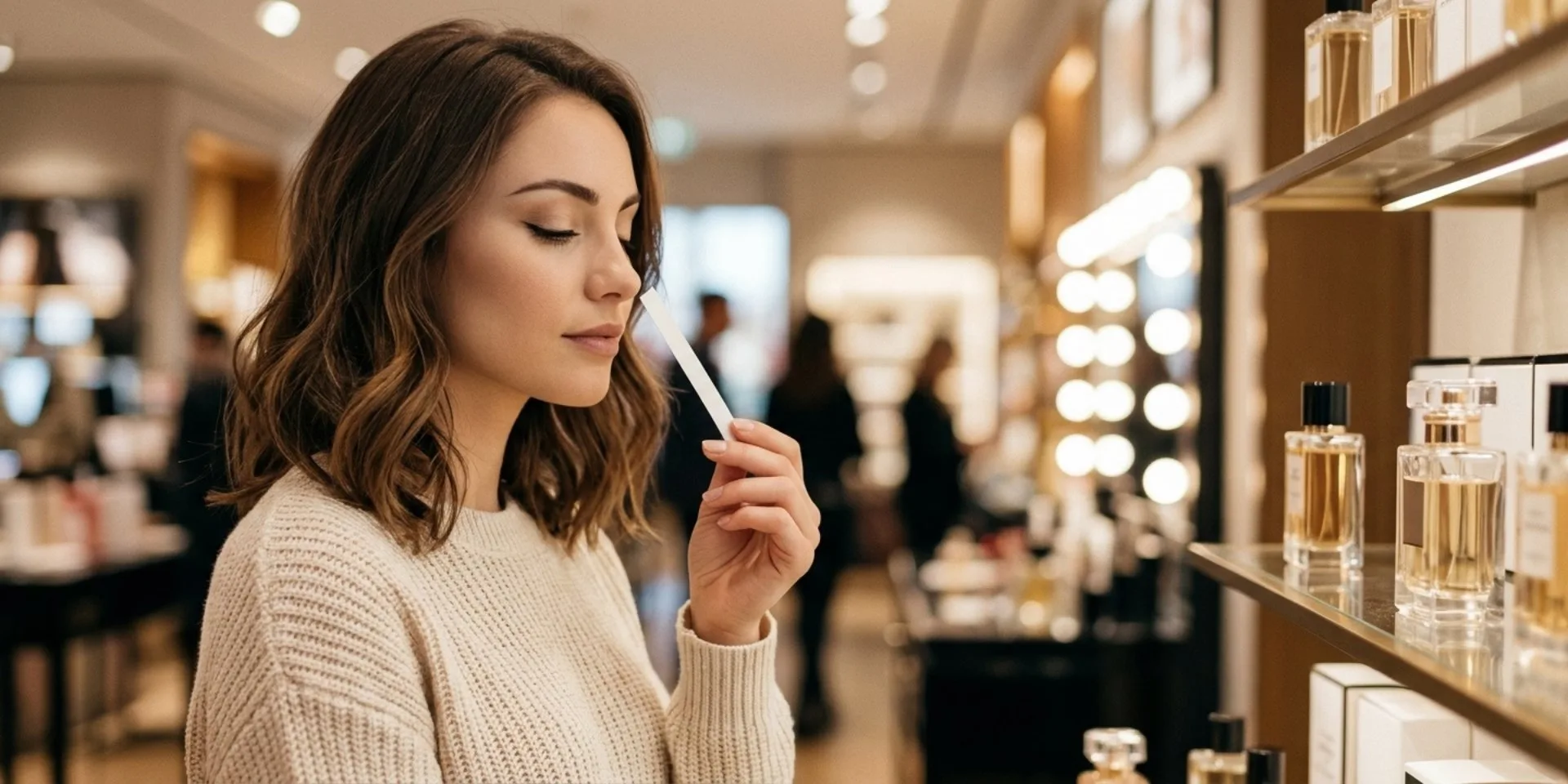
Why Does Perfume Smell Different on Different People?
You find a fragrance you love in a perfume shop. On the little white testing card, it smells beautifully balanced: perhaps fresh citrus softened by delicate florals, or a warm vanilla that feels inviting without being too sweet. You buy the bottle, wear it the following morning and discover something rather different. The citrus seems sharper, the vanilla has become heavier, or that beautiful floral quality you fell in love with has almost disappeared.
Perhaps you have had the opposite experience, too. Someone walks past wearing a fragrance you cannot resist, yet when you try the very same perfume, it simply does not have that quality. Why does perfume smell different on different people? And when a brand promises a scent that becomes uniquely yours, is it describing something genuinely different about its formulation or something ordinary perfumes already do?
Why does the same perfume smell different on your skin?
Perfume can smell different on different people because the skin affects how fragrance ingredients are released, the fragrance combines with natural body odour, and people perceive smells differently. This happens with ordinary perfumes as well as pheromone fragrances. The ingredients and carrier of a particular perfume can influence how noticeable the differences become, but a personalised scent is not proof of a special pheromone or pH-activated mechanism.
A testing card is useful for narrowing down your choices. Wearing the fragrance on your own skin is the better way to discover whether you actually enjoy it.
Why perfume smells different on paper than on skin
A perfume testing strip is a useful way to experience a fragrance without mixing it with the scent of your body or the products you are already wearing. But it is not an imitation of your skin. Paper absorbs fragrance into its fibres, while skin presents a living surface with moisture, natural lipids, texture and its own temperature. These differences can affect how much of each fragrance ingredient reaches the air and when you notice it.
There is also a question of timing. A fragrance is usually a mixture of aromatic ingredients with different rates of evaporation. The opening may be bright and airy, while the scent you notice later has a different balance of floral, woody or musky qualities. Perfumers often describe these stages as top, heart and base notes, although the transitions are rarely as neat as that description implies. A card you smell immediately and a perfume you wear for an afternoon are therefore not a fair comparison unless you allow both to develop over the same period.
| Where you test | What it helps you discover | What it cannot tell you |
|---|---|---|
| Paper fragrance strip | The fragrance character and which scents you want to explore further. | Exactly how the scent will develop alongside your natural body odour. |
| Your skin | Whether you enjoy the opening, changing balance and later scent during wear. | How every other person will perceive it. |
| Another person’s skin | How the fragrance smells in combination with that person’s individual scent. | Whether you will enjoy the same fragrance on yourself. |
Clothing offers another different surface, not a neutral substitute for skin. Different fabrics can retain and release fragrance differently, and some products may leave marks. If a manufacturer permits fabric application, it can be a useful alternative for a scent you enjoy away from your skin; it is not a reliable prediction of how that fragrance will wear on your body.
What does perfume skin chemistry actually mean?
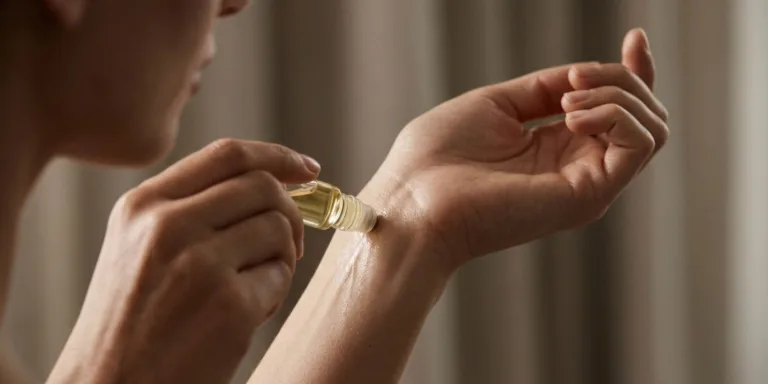
Skin chemistry is a convenient expression, but it can make the relationship between skin and perfume sound more mysterious than it needs to be. Your skin has measurable physical and chemical properties, including hydration, lipids, acidity, temperature and surface texture. Each fragrance ingredient has its own characteristics, including volatility and affinity for oily or watery environments. The interaction between the two can influence which ingredients remain on the surface and which are released into the surrounding air.
A 2025 study in the International Journal of Cosmetic Science examined fragrance evaporation alongside a range of skin measurements. The researchers found that the relationships varied between fragrance molecules: surface roughness was associated with the behaviour of more volatile compounds, while hydration and water loss through the skin were relevant to certain less volatile, more oil-affine compounds. This matters because a perfume is not a single substance. Altering the relative release of its ingredients can change the impression of the whole composition without changing the identities of those ingredients.
Moisture, natural oils and the skin surface
The surface of your skin is not the same from one person to the next, or even from one part of your body to another. An aromatic ingredient that has an affinity for lipids may be retained differently from one that readily evaporates. Moisture, the condition of the skin and products already on it can also influence the environment in which fragrance develops. There is no simple universal rule, however, that oily skin makes perfume sweeter or that dry skin always makes it disappear faster. Those outcomes depend on the composition as well as the wearer.
Temperature and the environment
Warmth can influence how readily volatile ingredients enter the air, while airflow changes how fragrance disperses around you. On a humid Queensland afternoon, a perfume may therefore feel more pronounced or develop differently than it does in an air-conditioned room. That does not mean warmer skin is always better for fragrance performance: quicker release can also change the balance or shorten the period over which a particular ingredient is noticeable. And the physical release of scent should never be confused with the biological activation of a pheromone.
Skin chemistry does not mean your perfume must undergo a chemical reaction.
Two people can wear the same composition and release different proportions of its ingredients into the air. The result can smell different even when the perfume molecules themselves remain chemically unchanged.
Your natural scent does not disappear when you wear perfume
Even skin that has recently been washed is not an entirely scentless canvas. Secretions from the skin and the microorganisms that live on its surface contribute to a personal mixture of odour-producing compounds. These natural odours may not be obvious to you, but they can form part of the scent another person experiences when you wear fragrance. The effect is more like adding another colour to a painting than replacing the canvas altogether.
In a 2012 series of experiments on perfume and human body odour, Lenochová and colleagues found that the combination of fragrance and an individual’s odour mattered to how people evaluated the resulting scent. In one experiment, the mixture made with the participant’s own chosen perfume was rated more favourably than a mixture made with an assigned perfume. The finding was not simply explained by how pleasant the perfumes smelled in isolation. It offers a compelling reason to judge a fragrance on the person wearing it, although it does not establish that everyone can instinctively identify their ideal fragrance.
Further research published in 2015 found that people could still discriminate between individual body odours in the presence of fragrance. In other words, perfume does not necessarily erase the scent differences that make one person distinguishable from another. These studies investigated body-odour mixtures and perception, rather than testing every commercial perfume or proving a particular skin-adaptive technology. Their relevance is the principle that the finished scent can be more than the fragrance alone.
Does your skin’s pH really change your perfume?
Skin pH describes the acidity of the skin surface. It is frequently mentioned in fragrance descriptions, particularly when a perfume promises to adapt to the person wearing it. It is tempting to imagine that each individual has a single pH value that transforms a perfume into their own signature scent. In practice, surface pH varies by body site and can be affected by washing, skin products and other conditions, while different fragrance molecules need not respond in the same way.
Research published in 1996, Insight into how skin changes perfume, explored physical and chemical interactions on skin. Across a range of relevant chemical groups, the investigators found limited chemical transformation under ordinary clean, dry skin conditions. They also demonstrated that a particular pH-sensitive reaction involving citral could be relevant in a specific product-mediated situation. The study is a useful reminder that chemical changes are possible, but they should not be assumed to occur to every perfume ingredient under normal wear conditions.
To establish a genuine pH-responsive benefit for a particular perfume, we would need to know which ingredients respond, how the changes occur within normal skin conditions and whether the effect is large enough to be noticed. Ideally, the finished product would be tested against an appropriate comparison fragrance. A pH measurement alone cannot tell you whether you will prefer a woody perfume to a floral one, or predict precisely how a particular bottle will smell on your wrist.
When a perfume promises a scent that is uniquely yours, what makes it different?
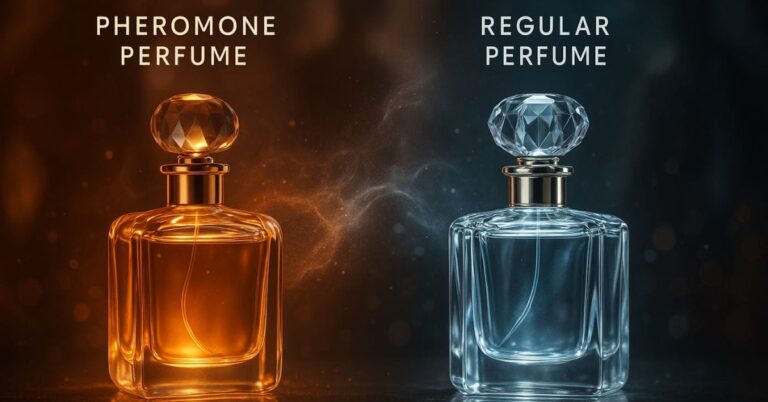
A fragrance that becomes personal to you is a beautiful idea. It is also one that appears across several different styles of perfumery, not just those containing ingredients marketed as pheromones. There are fragrances designed to produce a quiet, natural-smelling impression, compositions built around a particular aroma molecule, and brands that deliberately emphasise the relationship between fragrance and individual skin chemistry. These approaches are worth distinguishing because they do not all describe the same kind of product.
The ingredients can make a difference
Consider two hypothetical perfumes. One contains a bright, assertive mixture of aromatic materials that dominates the surrounding air, while the other is composed to produce a softer, more restrained effect. In the second case, the wearer’s own scent may be more apparent in the overall impression. Neither perfume needs a pheromone ingredient for that to happen. Individual materials, their relative concentrations and the carrier can also influence the way a composition releases scent; whether a specific design produces greater wearer-to-wearer variation is a question that needs testing.
There are real-world examples of this idea outside the pheromone category. Juliette Has a Gun describes its Not a Perfume fragrance as a skin scent centred on the aroma material Cetalox. Its identity rests on a particular approach to fragrance composition, rather than a claim about added pheromones. This illustrates that the idea of a scent that complements your natural smell is not confined to one category, although the manufacturer’s description is not itself a comparative scientific study.
Where do Pure Instinct and pheromone perfumes fit?
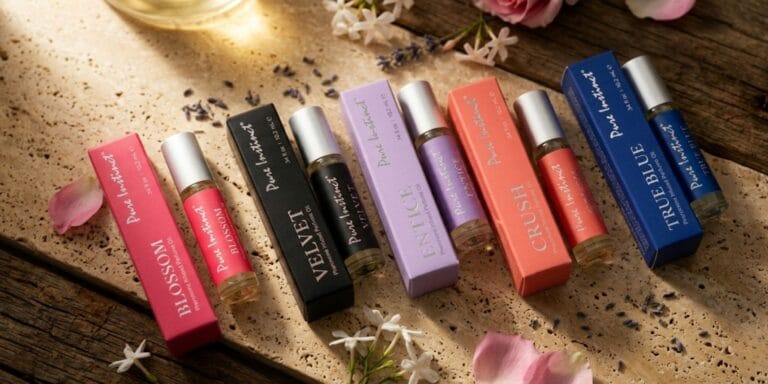
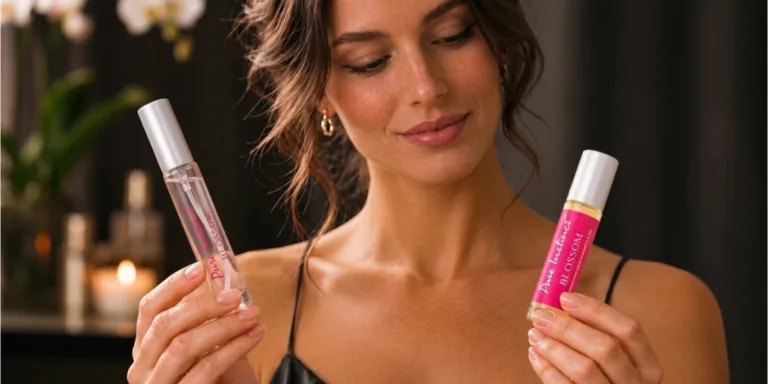
Pure Instinct describes its fragrances as formulated to harmonise with individual skin pH, and its Original roll-on is marketed around a personal scent experience. At Wildfire, we offer Pure Instinct fragrances in spray and roll-on formats, with contrasting scent profiles to suit different preferences. This makes the range an interesting example of a manufacturer deliberately positioning its fragrances around individual wear. It does not, however, establish that the added pheromone component is responsible for that individuality.
Independent research supports general mechanisms by which perfume can smell different on different people. We have not established through independent, product-specific comparative testing that Pure Instinct’s pH-related effect is exclusive to its formulation, or that its pheromone component causes a greater degree of personal scent development than a conventional perfume. Those are separate claims that would require separate evidence. If you are also interested in the research behind attraction claims, our guide to whether pheromone perfume works explores that question in detail.
| Fragrance claim | How to interpret it |
|---|---|
| Smells different on different people | Plausible for ordinary perfumes and pheromone fragrances; the degree of variation depends on the wearer and composition. |
| Designed to complement your natural scent | A formulation or sensory design intention. Whether you enjoy the result is best assessed by wearing it. |
| Adapts to your skin pH | A more specific chemical claim requiring evidence about the ingredients and finished product. |
| Pheromones make your perfume uniquely yours | Not established as a distinct mechanism by the research discussed here. |
A formulation can be thoughtfully designed around a personal fragrance experience without having to claim a mechanism that no other perfume possesses. The meaningful benefit for the wearer is discovering a scent that feels harmonious and enjoyable over the course of the day.
Sometimes it is your nose, not just your skin
Imagine you and a friend smell the same perfume strip at the same moment. You find it warm and comforting, while your friend notices a slightly sharp quality that you can barely detect. Neither of your skin surfaces is involved in that particular difference. What you are experiencing is the variability in how people detect and interpret odour.
Research into genetic variation in human olfactory receptors published in 2019 found associations between receptor differences and people’s perceptions of particular odours, including their intensity and pleasantness. This does not mean a genetic test can prescribe your perfect perfume. It does help explain why one person may notice a particular material that another finds very faint, or why the same smell can be described differently by two people. Experience, personal associations and the immediate context in which you encounter a fragrance also shape your judgement.
There is another familiar complication: when you wear a fragrance continuously, you may become less aware of it even though someone approaching you can still notice it. This is a different issue from perfume developing differently on your skin. Our guide to why you stop noticing your own perfume explains olfactory adaptation and how to avoid mistaking it for a fragrance that has completely faded.
Why does perfume smell sour, too sweet or simply wrong on me?
When a particular scent seems unpleasant on your skin, it is natural to look for an explanation such as acidity or a supposed incompatibility between your body and the fragrance. Yet the word sour is a description of an experience, not a chemical diagnosis. A note you dislike may become more prominent as the brighter ingredients fade, the perfume may combine differently with your natural scent, or something already on your skin may be contributing. It is worth exploring these possibilities before assuming your skin has an unusual pH.
| What you notice | A useful next test |
|---|---|
| It smells good on a card but sour on skin. | Try the same fragrance on clean, dry skin without other scented products, and compare it with a fresh strip over the same period. |
| It becomes too sweet or heavy. | Compare a lighter application on another day, and assess the later scent rather than buying on the strength of the opening. |
| It smells beautiful on a friend but not on you. | Test it on your own skin; ask a trusted person to smell it too, recognising that both your scent and their perception may differ. |
| Your usual perfume suddenly smells different. | Check for changes in skin products, environment, the bottle’s condition and the version of the fragrance before assuming a skin-chemistry change. |
Can your perfume smell different from day to day?
Yes, the experience need not be identical every time. You may wear it after a shower on one occasion, over a scented lotion on another, or in quite different weather. Even how much of the fragrance reaches you can change with movement, clothing and the place you applied it. Changes in natural body odour and how sensitive you are to smells can also contribute, so there is rarely one explanation that applies to every day.
If a familiar perfume develops an unusual smell in the bottle as well as on your skin, it is worth investigating the product rather than assuming your body has changed. Storage, ageing and possible formulation changes are distinct questions; our guide to whether perfume expires explains the signs to look for. If a fragrance causes irritation or discomfort, stop using it rather than experimenting with products intended to alter your skin.
Do perfume oils become more personal than sprays?
The carrier of a fragrance affects the way it is applied and can influence the release of aromatic ingredients. An alcohol-based spray distributes fragrance across a broader area and its solvent evaporates readily. A roll-on oil deposits a small amount of an oil-based preparation directly where you apply it. That makes a roll-on a particularly useful format to explore if you prefer precise application and a more discreet scent experience, although not every roll-on is subtle and not every spray is strong.
There is no general rule that only oils interact with body chemistry. Both formats can combine with your natural scent and be influenced by skin characteristics, and differences between particular products may reflect their aromatic composition, concentration, carrier and amount applied. The same advertised fragrance name across a spray and an oil does not guarantee identical behaviour, either. If you enjoy one format but find the other wears differently, that may be a perfectly reasonable consequence of the different preparations.
For a more detailed understanding of the format itself, explore our guide to what perfume oil is. If your main concern is how long you can smell a fragrance rather than how it changes in character, our guide to perfume longevity on skin covers the factors that affect wear time.
How to choose a perfume that smells beautiful on you
You do not need to know your skin’s pH or understand every ingredient in a fragrance to make a more considered choice. The most useful information comes from the way a fragrance actually wears on you, compared under reasonably consistent conditions. Think of the perfume counter as the beginning of that process, rather than the place where you have to make the final decision.
1. Use fragrance strips to narrow your choices
Start by identifying the scents you genuinely enjoy, without trying to test everything in one visit. Label the strips so you can remember which perfume is which. Give the opening time to settle before revisiting them. A favourite on paper deserves a place on your shortlist, but it has not yet earned a place in your collection.
2. Test a small amount on clean skin
Choose one or two finalists, follow the product’s directions and apply them to separate areas of suitable, intact skin. Avoid layering with a strongly scented lotion or another perfume during this comparison. Allow the fragrance to develop without repeatedly adding more. If you have known fragrance sensitivities, check the ingredient information first; a scent test is not a test for allergies or a guarantee that a product is suitable for your skin.
3. Experience the fragrance outside the shop
Perfume counters can be filled with competing aromas, making it difficult to focus on the one you are considering. Go about your day and revisit the fragrance once you are away from that environment. Notice the opening, its development and the scent that remains later. An interval of half an hour and a later check after a few hours are convenient personal comparison points, not universal stages of perfume development.
4. Compare the card and skin at the same time
If you are curious about why a fragrance changes on you, apply it to a fresh strip and to your skin at approximately the same time, using the recommended amount for skin. Revisit both at similar intervals and write down what stands out rather than trying to identify every molecule. You might find the later balance is equally sweet on the strip, or that it is only unpleasant on your skin. The comparison cannot isolate every scientific variable, but it gives you more useful information than comparing an opening impression in the shop with a dry-down hours later.
5. Choose the experience, not just the description
Fragrance descriptions can help you recognise a family you enjoy, but they cannot substitute for the experience of wearing it. Ask yourself whether you still like the scent later in the day, whether it suits the places you will wear it, and whether you feel comfortable with how noticeable it is. Where samples or smaller formats are available, consider them before committing to a larger bottle. A scent can be sophisticated, popular and beautifully composed without being the right fragrance for you.
There is nothing you need to fix about your skin to enjoy perfume.
If a fragrance you loved on a testing card does not suit you, it is reasonable to choose another. Finding a fragrance you enjoy wearing is more valuable than trying to change your body’s chemistry to accommodate a purchase.
Frequently asked questions
Does every perfume smell different on everyone?
Any perfume can be influenced by the wearer and the person smelling it, but not every composition will show a noticeable difference on every person. Some scent profiles may remain recognisable across wearers, while others seem more variable. The degree of difference depends on the composition, conditions and individual perception.
Why does perfume smell better on other people?
You are smelling a combination of the fragrance, the person’s natural odour and the stage of wear. You may also be encountering it from a different distance than when you smell your own wrist. Test the same fragrance on yourself and allow it to settle before deciding whether the difference matters to you.
Can I test my skin pH to find the right perfume?
A skin pH measurement cannot reliably predict your preferred fragrance. Surface acidity is one characteristic among many, and we do not have a universal mapping between pH and how finished perfumes smell. Actual wear testing is more useful for choosing a scent you enjoy.
Are pheromone perfumes the only perfumes that adapt to your skin?
No. Conventional perfumes can also develop differently on different people. Some brands deliberately emphasise personal scent development, but the claim that an added pheromone ingredient uniquely causes this effect requires product-specific evidence.
Should I apply moisturiser before testing perfume?
For an initial comparison, keep your skin-care routine consistent and avoid competing scents. If you normally wear an unscented moisturiser, you can test again under your usual conditions to see whether you prefer the result. Moisturising is not a guaranteed way to improve every fragrance or extend its wear.
How long should I wait before deciding if I like a perfume?
Give it enough time to move beyond the opening and check it again later during normal wear. Different perfumes develop at different rates, so there is no exact waiting period that works for every composition. If possible, try the fragrance on another day before making a substantial purchase.
Is a perfume that smells different on me defective?
Not necessarily. Individual scent variation is a normal possibility with fragrance. If the perfume smells markedly different in the bottle, appears altered, or you suspect a packaging or formulation issue, check with the retailer or manufacturer rather than attributing everything to your skin.
Research and references
This guide draws on research into fragrance evaporation, skin interactions, human body odour and olfactory perception. These sources support general explanations of scent development; they are not independent comparative efficacy tests of the commercial fragrances mentioned.
- Exploring the impact of fragrance molecular and skin properties on the evaporation profile of fragrances. International Journal of Cosmetic Science, 2025.
- Insight into how skin changes perfume. International Journal of Cosmetic Science, 1996.
- Psychology of fragrance use: perception of individual odour and perfume blends. PLOS ONE, 2012.
- Effect of fragrance use on discrimination of individual body odour. Frontiers in Psychology, 2015.
- Genetic variation across the human olfactory receptor repertoire alters odour perception. PNAS, 2019.
- Magdalena Wajrak: why the same perfume smells different on different people. The Conversation, republished by The National Tribune, 2026.
Manufacturer positioning
Pure Instinct’s brand story and Original roll-on description, and Juliette Has a Gun’s Not a Perfume description, were consulted to distinguish marketing positioning from independent scientific findings.
Discover a fragrance that feels like you
From bright, luminous fragrances to warmer, more intimate scents, explore our collection of perfume sprays and roll-on oils. Begin with the notes you are naturally drawn to, then give the fragrance time to become part of your own everyday experience.