
How to Layer Perfume Without Overdoing It
You love two perfumes individually, but wearing them together creates something entirely different. One fragrance seems to overpower the other, the sweetness becomes too intense, or the combination simply doesn’t smell as good as you imagined. It is an understandable frustration, particularly when both perfumes are ones you genuinely enjoy.
Successful perfume layering is not about wearing more fragrance. It is about understanding how different scent profiles interact, recognising which fragrance should take the lead and knowing when a lighter touch will create a better result. Even two beautifully composed perfumes can compete with one another when their intensity or aromatic character is poorly balanced.
Whether you prefer perfume oils, traditional sprays or the deeper character of a woody cologne, learning how to layer fragrance thoughtfully can help you discover new ways to enjoy the scents you already own. The secret is knowing what to combine, how much to apply and when to stop.
How do you layer perfume without making it overpowering?
Start with two complementary fragrances, choosing one as your main scent and the other to introduce warmth, freshness, softness or depth. Test them together on separate fragrance strips before applying small amounts to your skin. If one fragrance is particularly strong, use less of it and allow both scents to develop before adding more. The aim is to create balance, not simply a stronger fragrance.
Why Some Perfumes Work Better Together Than Others
Perfume layering, sometimes called fragrance layering, is the practice of wearing two or more fragrances together to create a different scent experience from wearing either fragrance alone. It might involve combining two spray perfumes, introducing a perfume oil beneath a spray or using a delicately scented body product alongside your usual fragrance. Rather than permanently mixing perfumes, layering allows you to experiment with different combinations and adjust them whenever you wish.
Imagine a floral perfume that you love but occasionally wish felt a little warmer or softer. Introducing a subtle vanilla fragrance may change the way you experience its floral notes. Equally, a fresh citrus scent may bring an interesting brightness to a rich, woody cologne. Each fragrance contributes something different, creating a combined impression that neither necessarily offers on its own.
Why two beautiful perfumes can smell unpleasant together
A finished perfume is already a carefully composed combination of fragrance materials. When you introduce another finished perfume, you are bringing two complete compositions together, not simply combining two individual fragrance notes. Their sweetness, freshness, intensity and underlying character may complement one another, but they can also compete. This is particularly noticeable when both perfumes have bold, distinctive scent profiles.
The way a fragrance develops is equally important. Two perfumes might smell beautiful together when first applied, only to become noticeably sweeter or heavier as their fresher opening notes fade. Assessing a combination solely on its initial scent can therefore be misleading. Giving the fragrances time to settle helps you understand whether they remain appealing together beyond that first impression.
Not every perfume needs a partner.
Some fragrances are so beautifully balanced on their own that introducing another scent distracts from their character. Successful fragrance layering includes recognising when your favourite perfume is already everything you want it to be.
How to Choose Complementary Fragrances
You do not need to understand every ingredient in a perfume to begin experimenting with fragrance layering. Start by identifying its dominant character. Does it feel fresh and citrusy, soft and floral, sweet and comforting, or deep and woody? Recognising what you notice most about a fragrance makes it easier to decide what another scent might contribute.
Look for a shared fragrance note
Perfumes that share a prominent fragrance note can provide a useful starting point. A rose perfume with a soft vanilla base, for example, may complement another fragrance in which vanilla is more noticeable. Similarly, two fragrances containing sandalwood may share a sense of warmth even when their floral or citrus characteristics differ. The shared note creates a familiar thread between the two compositions.
Remember, however, that a shared fragrance note does not guarantee compatibility. Two perfumes containing vanilla can differ considerably in sweetness, richness and intensity. One might be delicate and creamy, while another is deliberately bold and dessert-like. Consider the overall character of each perfume rather than relying exclusively on its published fragrance notes.
Use contrasting fragrances to create balance
Complementary fragrances do not necessarily need to smell similar. Contrasting scent profiles can create particularly interesting combinations when each introduces a quality the other lacks. Bright citrus may bring freshness to a warm amber fragrance, while a gentle woody scent can give a sweet perfume a more grounded impression. A soft musk may also provide a subtle contrast to vibrant fruity notes.
Consider the strength of each perfume
Intensity is often more important than choosing fragrances from matching scent families. A delicate floral perfume may become almost impossible to notice beside a powerful woody fragrance, even if their notes appear compatible. Conversely, combining two fragrances that are both sweet and expressive may create a heavier scent than you intended. Start with fragrances whose relative strengths allow you to appreciate the combination rather than forcing them to compete.
Choose the perfume you most want to notice and let the second fragrance introduce something more subtle. That might be a little warmth, freshness, softness or depth. Thinking in terms of a leading scent and a supporting scent makes fragrance layering considerably easier to approach.
Nine Perfume Layering Combinations Worth Trying
If you are unsure which fragrances to combine, the following pairings offer practical starting points. Look for these scent characteristics in perfumes you already own, rather than feeling that you need to purchase a particular fragrance for layering. The combinations are suggestions to explore, not fixed rules, because the complete formulation and intensity of each perfume will influence the result.
| Fragrance combination | Possible scent character | Why it may work |
|---|---|---|
| Vanilla + Amber | Warm, enveloping and sweet | Adds richness and depth to a comforting vanilla fragrance. |
| Citrus + Sandalwood | Fresh, creamy and grounded | Balances citrus brightness with woody warmth. |
| Rose + Vanilla | Soft, floral and gently sweet | May soften the impression of a prominent rose fragrance. |
| White Florals + Soft Musk | Delicate, smooth and understated | Introduces softness without necessarily adding more sweetness. |
| Bergamot + Patchouli | Fresh, earthy and distinctive | Creates contrast between citrus freshness and earthy depth. |
| Coconut + Vanilla | Creamy, tropical and comforting | Explores a warmer, sweeter fragrance character. |
| Citrus + Aromatic Herbs | Crisp, green and refreshing | Introduces a botanical quality to fresh fragrances. |
| Woods + Warm Spices | Rich, textured and warm | Adds complexity to a woody fragrance. |
| Fruity Notes + Soft Musk | Bright, smooth and gently rounded | May soften the impression of vibrant fruit notes. |
Which fragrance combinations should you be careful with?
There are no universally incompatible fragrance families, but some combinations may be more challenging to balance. Two intensely sweet perfumes can become cloying, while two bold, smoky or heavily spiced fragrances may compete for attention. Complex floral perfumes can also lose their individuality when paired with another equally expressive floral composition. These combinations are not necessarily wrong, but they may benefit from more restrained application.
If a pairing appeals to you, begin with a much lighter application of the stronger fragrance. You may discover that the same two perfumes work beautifully together at different proportions.
How to Layer Perfume Step by Step
You do not need a large perfume collection or specialist equipment to begin experimenting. Two fragrances, a few fragrance testing strips or pieces of clean, unscented paper, and a little patience are enough to explore how different scents work together. The following approach helps you test your combinations without committing to an overpowering fragrance for the rest of the day.
Decide what you want to change
Begin with a fragrance you already enjoy and consider what you would like another perfume to introduce. Perhaps your favourite daytime scent feels too delicate for an evening out, or a rich cologne feels heavier than you would prefer on a warm afternoon. Choosing a particular direction gives your layering experiment a purpose. It also makes it easier to recognise whether your second fragrance is improving the combination.
Test each perfume on a separate fragrance strip
Apply a small amount of each perfume to its own strip and allow the initial scent to settle. Hold the strips near one another and gently move them towards you to experience the fragrances together. You can then separate the strips to identify which scent is dominating or contributing a quality you enjoy. This is especially useful when experimenting with unfamiliar or powerful fragrance combinations.
Apply smaller amounts than you normally would
Once a pairing appeals to you, begin testing it on your skin with a light application of each fragrance. Avoid automatically wearing your usual amount of both perfumes, as this may create a considerably stronger overall impression. Use less of whichever fragrance is more powerful and follow the individual product’s application directions. It is much easier to introduce more scent later than to remove an application that feels excessive.
Experiment with different application areas
You can apply two fragrances to the same area of skin, allowing the first to settle before introducing the second. Alternatively, try applying them to separate areas, such as one fragrance on your wrists and another near your neck. Separate application allows their aromas to mingle around you without placing both products directly on top of one another. This can be helpful when a combination smells muddled or too concentrated in one place.
Allow the fragrances to develop naturally
The first impression of a perfume is only part of its character. As its more noticeable opening notes fade, other aspects of the fragrance may become more apparent, a development commonly referred to as the dry-down. Reassess your combination once it has settled and again later in the day. What initially feels bright and refreshing may gradually become sweeter, warmer or more intense than you expected.
Adjust one thing at a time
If the combination is not quite right, change one aspect on your next attempt. Reduce the stronger fragrance, reverse the application order or move the fragrances to separate areas of skin. Changing everything at once makes it difficult to recognise what improved the result. A thoughtful approach to experimentation can reveal more than repeatedly adding another fragrance.
You do not need to make a fragrance louder to make it more interesting. Sometimes, the most captivating combination is the one that reveals itself gently rather than announcing itself before you enter the room.
Layering Perfume Oils, Sprays and Body Mists
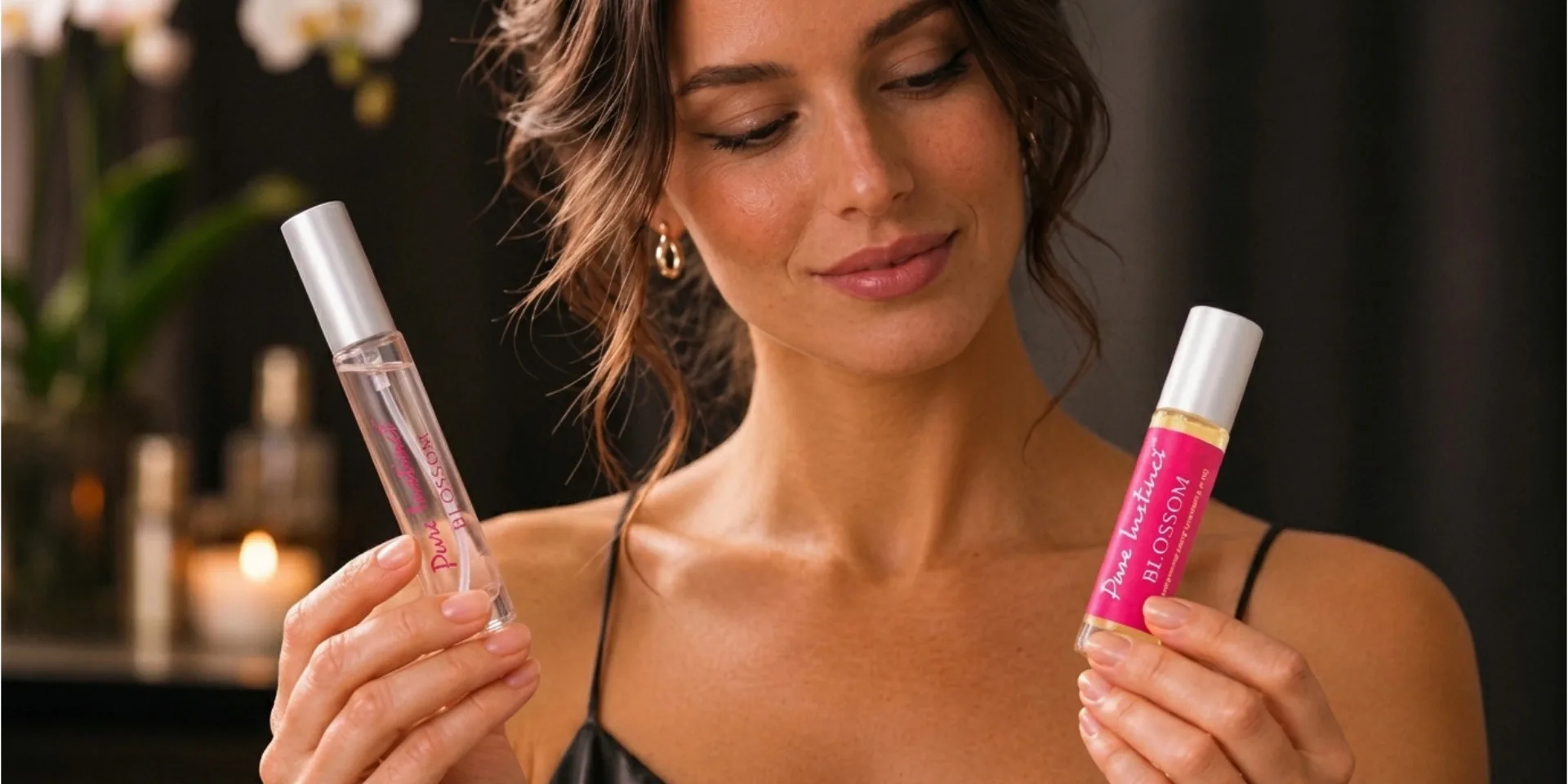
Fragrance layering does not have to involve wearing two traditional spray perfumes. Different fragrance formats offer different ways of introducing scent, which can be particularly useful when you want to create a subtle supporting layer. A roll-on perfume oil allows for targeted application, while a spray may create a broader fragrance impression. Scented body products can also contribute an aromatic background to your usual perfume.
Should you apply perfume oil or spray first?
Applying perfume oil before a spray is a practical starting point, particularly when you want to use the oil as the foundation of your fragrance combination. Apply a small amount to the intended area and allow it to settle before introducing the spray. This gives you an opportunity to appreciate the oil’s character and decide how much additional fragrance you actually want to wear.
However, applying oil first is not a universal rule. If your perfume oil is particularly expressive, you may prefer to wear it sparingly alongside a lighter spray on a separate area of skin. Similarly, applying a small amount of oil after your spray may work better when you want the spray to remain the dominant fragrance. The relative intensity of the products matters more than following a fixed application order.
If you are unfamiliar with oil-based fragrances, our guide to what perfume oil is explains how this fragrance format differs from traditional spray perfumes.
Can you layer scented body oil with perfume?
A scented body oil can introduce fragrance as part of your everyday body care routine without necessarily requiring a separate perfume. If you enjoy wearing a body oil with a noticeable aroma, consider how that scent might complement the perfume you intend to apply afterwards. A body oil with rich botanical notes, for example, may already provide enough aromatic character without needing another equally expressive fragrance.
Wildfire’s scented four-in-one oils offer another way to enjoy fragrance through body care and massage. Their aroma can form part of the overall scent experience when used as directed, although they are not the same product format as a concentrated personal perfume oil. If you choose to introduce a perfume alongside a scented body oil, begin with a light application and assess how their aromas work together.
Combining body mists with perfume
Body mists can offer another way to introduce a supporting fragrance. A delicately scented vanilla mist, for example, may complement a floral perfume, while a fresh citrus mist might sit alongside a warmer fragrance. However, the combined intensity still depends on the individual formulations and the amount you apply. Choose products specifically intended for body or hair application and follow their individual directions.
Does layering perfume make it last longer?
Layering may change how long you continue to notice your overall fragrance combination, but it does not automatically extend the performance of every perfume involved. The formulations, application amounts, environment and your own perception of scent all play a role. A supporting perfume oil may remain noticeable after a lighter spray has faded, although that does not necessarily mean it has prolonged the original spray itself.
If fragrance longevity is your main concern, our guide to how long perfume lasts on skin explores the factors worth considering before adding more fragrance to your routine.
Can you layer pheromone perfume with regular perfume?
Pheromone perfumes can be explored alongside other personal fragrances using the same principles of scent compatibility, application and balance. Choose combinations according to how their aromas work together rather than assuming that wearing multiple products will increase their effects on attraction. Enjoying the way a fragrance smells is a meaningful reason to wear it, independently of any claims about how other people might respond.
If you specifically wear an oil-based pheromone fragrance, our guide to how to use pheromone oil explores application and layering considerations for that fragrance format.
Choose products intended for personal use.
Perfume oils, body oils, essential oil blends and room fragrances are not interchangeable. Only apply products to the skin when they are specifically intended for that use. Concentrated essential oils and diffuser blends should not be applied directly to the skin simply because their fragrance appeals to you.
How to Layer Cologne Without Overdoing It
The same principles of fragrance layering apply to cologne, whether a fragrance is traditionally marketed towards men or women. Start by considering what you enjoy about your existing cologne and what another fragrance could introduce. A fresh aromatic scent may take on a warmer impression when combined with soft woods, while citrus may bring brightness to a richer, spiced fragrance.
When combining two bold colognes, pay particular attention to the total amount you apply. Two fragrances with strong projection may become overwhelming together, even when they smell appealing individually. Begin with smaller amounts, consider separate application areas and assess the combination after its dry-down. This is particularly useful when wearing fragrance in offices, restaurants or other enclosed environments.
You also do not need to restrict your choices to fragrances marketed for the same gender. A soft vanilla, floral or amber perfume may complement a traditional woody cologne, just as fresh aromatic notes may introduce an interesting contrast to a sweeter perfume. Choose according to the fragrance itself rather than the label on the bottle.
What to Do When Your Fragrances Clash
Even fragrances that appear complementary may produce a disappointing combination. One perfume might become almost impossible to notice, the overall scent may feel heavier than intended, or the fragrances may develop an unpleasant character as they settle. Rather than immediately dismissing the combination, identify what you dislike about it. Sometimes a simple adjustment in application is enough to create a more enjoyable result.
| The problem | What to try instead |
|---|---|
| One fragrance overwhelms the other | Reduce the stronger fragrance or apply the two scents to separate areas of skin. |
| The combination feels too sweet | Reduce the sweeter fragrance or try a fresh, green or woody supporting scent next time. |
| The fragrances smell muddled | Replace one complex perfume with a simpler, more understated fragrance. |
| The overall scent is overpowering | Reduce the total amount of fragrance rather than introducing another perfume to balance it. |
| The combination becomes unpleasant later | Test the pairing through its dry-down before committing to another full application. |
| You stop noticing one of the fragrances | Consider whether it has faded, is being masked by the other perfume or has become less noticeable through olfactory adaptation. |
Why adding another perfume is rarely the solution
When a combination already feels too strong, introducing a third perfume can make it even more difficult to achieve the balance you want. Rather than trying to cover an unwanted fragrance with another scent, allow the original application to settle or gently wash the area if necessary. On your next attempt, begin with a smaller amount or experiment with a different supporting fragrance. Some perfumes are simply more enjoyable when worn individually, and recognising that is part of learning how to layer well.
Are you wearing too much perfume or simply noticing it less?
It is possible to become less aware of a fragrance you have been wearing for some time, even when other people can still notice it. This is commonly associated with olfactory adaptation, sometimes called nose blindness. Adding more perfume because you can no longer smell your original application may therefore create a stronger fragrance impression than you realise.
Our guide to why you can’t smell your perfume when others still can explores this experience and why it is worth considering before reapplying or adding another fragrance.
Be mindful of sensitive skin and shared spaces.
Layering multiple scented products can increase your exposure to fragrance ingredients. Avoid applying perfumes to irritated or broken skin, follow individual product directions and discontinue use if irritation occurs. If you have a known fragrance sensitivity, using fewer scented products or choosing fragrance-free alternatives may be more appropriate. Respect fragrance-free environments and consider the comfort of others in shared spaces.
Get More From the Fragrances You Already Own
One of the pleasures of perfume layering is rediscovering fragrances that have gradually found their way to the back of your collection. Perhaps a perfume you once loved now feels a little too sweet, or a fragrance purchased for a particular occasion rarely feels right for everyday wear. Introducing a complementary scent may give you a different way to experience that perfume without needing to replace it. Start with what you already own before deciding whether anything is missing from your collection.
Adapt a favourite fragrance for different occasions
The perfume you enjoy during the day may also work beautifully in the evening with the introduction of a warmer supporting fragrance. Equally, a rich winter perfume might feel more approachable during the warmer months when paired with a fresh, lighter scent. Experimenting with these contrasts allows you to explore different expressions of a familiar perfume rather than feeling that every occasion requires another purchase.
Choose supporting fragrances rather than more of the same
If you do decide to expand your fragrance collection, consider what would complement the perfumes you already enjoy. A soft musk, a fresh citrus fragrance or a gentle woody perfume may offer more versatility than another bold fragrance with a similar profile to your existing favourites. Different application formats can also be useful. A roll-on perfume oil, for instance, allows you to introduce fragrance to a small area without necessarily adding another full spray application.
If you would like to explore this approach, Wildfire’s collection of roll-on perfume oils offers a different fragrance format to experiment with alongside the perfumes you already own.
Remember the combinations you enjoy
When you discover a fragrance combination you particularly enjoy, make a note of the perfumes involved, the order in which you applied them and approximately how much of each you used. It is also worth recording how the combination developed throughout the day, rather than simply whether you enjoyed its opening notes. These observations can help you recognise which fragrance characteristics work well together and which combinations you would prefer to avoid. Over time, layering becomes less about following suggested pairings and more about understanding your own fragrance preferences.
Frequently Asked Questions About Perfume Layering
Can you layer two different perfumes?
Yes. Wearing two different perfumes together can create an interesting fragrance combination when their aromatic characteristics and intensity are well balanced. Start with smaller amounts of each fragrance and allow the combination to develop before deciding whether to apply more.
Should you apply the stronger or lighter perfume first?
Applying a small amount of the stronger fragrance first, followed by a lighter scent, is a useful starting point. However, there is no universal application order that works for every perfume. Experiment with different proportions and application areas to discover what creates the most enjoyable balance.
What are the easiest fragrances to layer?
Perfumes with a relatively simple or understated aromatic character can be easier to experiment with. Soft musk, vanilla, citrus and gentle woody fragrances offer several possibilities. Their suitability ultimately depends on the complete fragrance composition and its intensity.
Can you layer perfume oil with eau de parfum?
Yes. Try applying a small amount of perfume oil first, allowing it to settle before introducing your eau de parfum. If either fragrance dominates the combination, consider reducing the amount applied or wearing the two fragrances on separate areas of skin.
How many perfumes should you layer at once?
Two fragrances are a practical starting point. Introducing additional perfumes makes it more difficult to identify which fragrance is contributing to the overall scent. Once you understand how two perfumes work together, you can explore more complex combinations if you wish.
Can you layer perfumes from different brands?
Absolutely. Fragrance layering does not require perfumes from the same brand or collection. Consider their aromatic character, relative strength and intended application rather than their brand name.
Can layering perfume make it smell worse?
Yes. Two individually appealing perfumes may create an unpleasant combination if their aromatic characteristics compete or their combined intensity becomes overwhelming. Testing fragrances on separate scent strips and beginning with smaller applications can help you identify unsuitable combinations before committing to them.
Should you mix two perfumes together in one bottle?
It is generally preferable to keep your perfumes separate and combine them through individual applications. Different formulations may not mix predictably, and permanently combining perfumes removes your ability to adjust their proportions or enjoy either fragrance independently.
A Little Fragrance. A World of Possibilities.
Sometimes all your favourite perfume needs is a subtle companion. Discover roll-on perfume oils that offer another way to introduce warmth, freshness or depth to your fragrance ritual, whether enjoyed individually or alongside the scents you already love.