
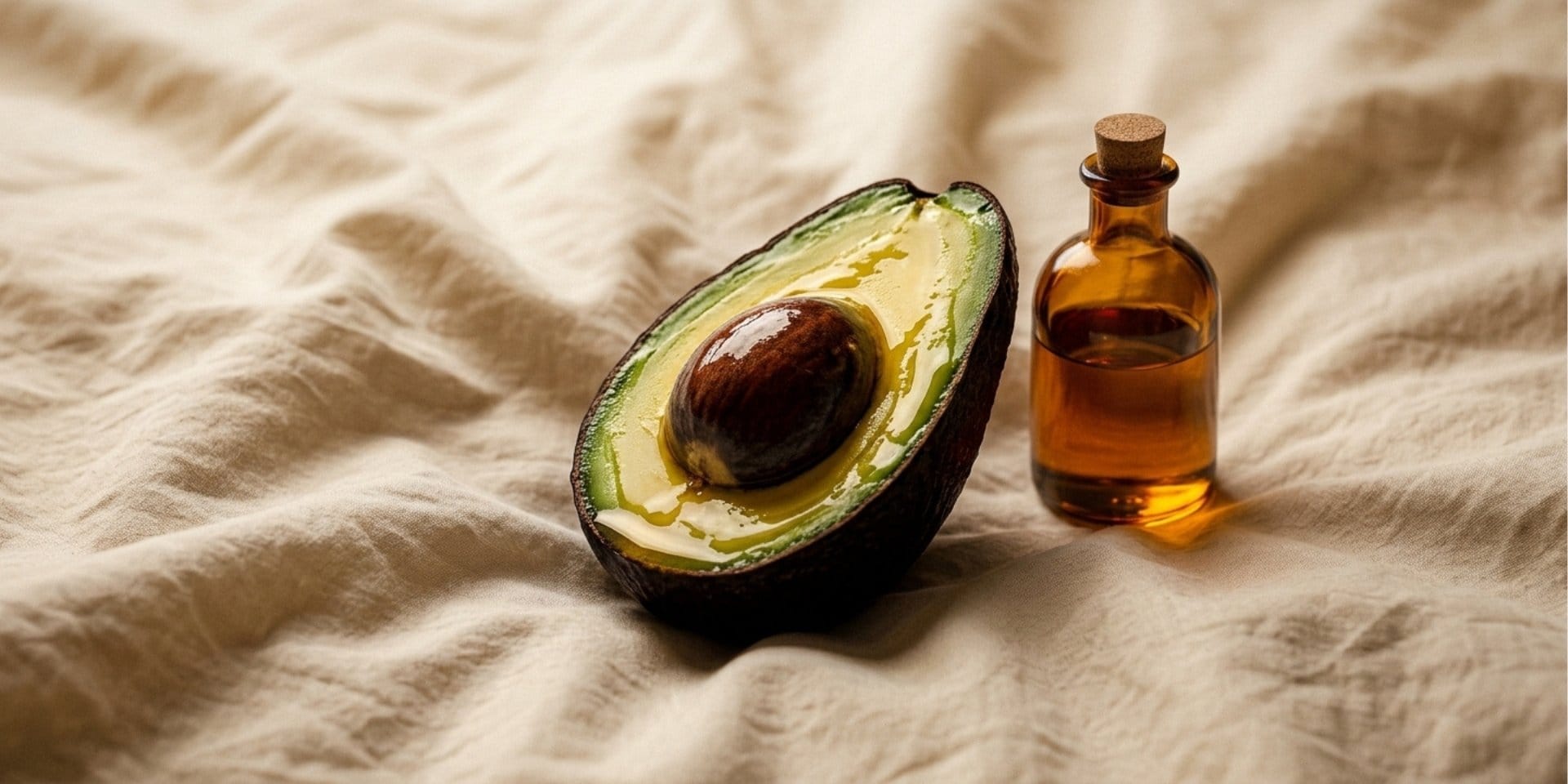
Can You Use Avocado Oil as Lube?
Avocado oil can provide long-lasting oily glide, but whether it is a good choice for intimate use depends on what is actually in the bottle, how your skin responds and whether condoms or contraceptive barriers are involved.
Avocado oil is rich, slippery and plant-based. If you already have a bottle at home, using avocado oil as lube can seem like a fairly logical idea.
So, can you use avocado oil as lube?
Pure avocado oil can provide the long-lasting slip people expect from an oil-based lubricant. But whether it is the right choice for you depends on more than whether it feels slippery.
Which avocado oil are you actually using? Is it pure, blended, refined or infused? Are you using condoms or contraceptive barriers? Where are you planning to use it? And are you simply looking for lubrication, or something that can become part of massage, body care and intimate touch?
Those questions matter more than trying to label avocado oil as simply “good” or “bad”.
Can avocado oil be used as lube?
Avocado oil can provide lasting oily glide, but not every bottle labelled avocado oil is necessarily the same product.
Check the complete ingredients, consider your own skin sensitivity and remember that oil-based products are not compatible with latex condoms. If you are using condoms or contraceptive barriers, check product compatibility before use.
Before you reach for the pantry bottle, what is actually in it?
There is nothing inherently wrong with an oil simply because it came from your kitchen.
The more useful question is whether you know exactly what is in the bottle.
“Avocado oil” can describe products that have been produced and processed in different ways. You may have 100% avocado oil. Someone else may have a refined avocado oil, an oil blend or a culinary product infused with flavours, herbs or other ingredients.
Even products sold as pure avocado oil can vary according to the fruit, extraction method, refining, storage and age of the oil.
That variation is not just theoretical. Researchers from the University of California, Davis have examined commercially available avocado oils and found significant differences in quality and authenticity. In a 2020 study of US retail samples, some products were oxidised or contained substantial amounts of other oils. A later study of private-label avocado oils also found considerable variation in purity and advertised quality.
This does not mean you should assume the avocado oil in an Australian pantry is adulterated. The studies looked at products from other markets.
What they do demonstrate is that the words avocado oil on the front of a bottle do not necessarily tell you everything about the product inside.
For intimate use, turn the bottle around. Read the complete ingredient list rather than choosing a product simply because the front label says “avocado oil”.
Does cold-pressed, virgin or refined avocado oil make a difference?
These terms describe oils that have undergone different methods of extraction and processing.
Virgin or cold-pressed avocado oil is generally produced mechanically with relatively little processing. Refined oil undergoes additional processing that can remove colour, aroma, flavour and other characteristics of the crude oil. Oil refining can include processes such as deodorisation and bleaching.
That does not mean refined avocado oil is automatically unsafe, nor does “cold-pressed” automatically make an oil suitable for intimate use.
They are simply different finished ingredients.
This is an important distinction because words such as natural, pure and cold-pressed can sound like complete answers when they are really only pieces of information.
If you are considering using an oil on sensitive areas of the body, knowing the complete product is more useful than relying on one appealing word on the label.
If avocado oil gives you good glide, isn’t that enough?
Sometimes it might be.
If what you want is simply an oil that reduces friction and stays slippery for a long time, it is easy to understand why avocado oil is considered as a lube alternative.
Unlike water, oil does not quickly evaporate from the skin. That can give it the persistent glide some people prefer.
But something being slippery and something being the right product for your particular intimate use are not quite the same question.
Before using any oil intimately, consider:
- what is actually in the bottle, including any added ingredients;
- where you intend to use it and whether the product feels comfortable there;
- whether condoms or contraceptive barriers are involved;
- how your own skin responds to the oil;
- how much residual oil you want left on your skin; and
- whether transfer to clothing or bedding matters to you.
Oil can transfer to fabrics and may leave marks on some materials. That is not a weakness unique to avocado oil. Oil-based sensual products, including Wildfire Pleasure Oils, can transfer to fabrics too.
The purpose of asking these questions is not to make avocado oil sound worse than another plant oil. It is to decide whether its characteristics actually suit what you are trying to do.
If you’re using condoms or contraceptive barriers, check compatibility first
Oil-based products can be incompatible with some condoms and contraceptive barriers, depending on the material they are made from.
That applies to avocado oil, cooking oils, massage oils and other oil-based products.
Wildfire Pleasure Oils are oil-based too, so we would not suggest replacing avocado oil with a Pleasure Oil and assuming the compatibility issue has disappeared.
Some barrier materials may be compatible with oil while others are not, so the safest approach is to check the instructions for the specific condom or contraceptive barrier you are using.
Using condoms or contraceptive barriers?
If you are using condoms or contraceptive barriers, check product compatibility before use. Do not assume that a product is compatible simply because it is natural or plant-based.
So if avocado oil can work as lube, why does a formulated sensual oil exist?
This is where the question becomes much more interesting.
If you have a pure avocado oil you like, your skin is comfortable with it, you understand the limitations of an oil-based product and all you want is oily glide, straight avocado oil may be enough for you.
We don’t need to pretend otherwise.
But lubrication is only one characteristic that can be considered when a sensual body oil is formulated.
A single carrier oil gives you the natural characteristics of that particular oil: its texture, spread, absorption, aroma and residual skin feel.
A finished sensual oil can instead bring together carrier oils, botanical infusions and aromatic ingredients to create a more deliberate balance of:
- glide and spreadability;
- how the oil feels across larger areas of the body;
- how long it remains workable during massage;
- how the skin feels afterwards;
- aroma and atmosphere; and
- the overall ritual surrounding touch.
That difference is important to Wildfire because our Pleasure Oils were never conceived simply as substances that make skin slippery.
Using plant oils on the body is anything but a new idea
Long before shops separated products into cooking oils, body oils, perfumes, massage oils and sexual wellness, people were using plant oils and aromatic botanicals to care for and scent the body.
Archaeological collections preserve ancient Egyptian vessels once used for perfumed oils, ointments and cosmetic preparations. In ancient Greek and Roman body care, olive oil also had an established role in cleansing, massage and keeping the skin supple.
The exact traditions varied enormously between cultures, places and periods. So did the beliefs surrounding particular herbs, flowers, aromas and plants associated with love, attraction, fertility and sensuality.
Not every historical belief should be treated as modern scientific fact.
But the broader idea is important: oils, botanicals, aroma, touch and the experience of the body have been connected for a very long time.
Wildfire grew from a fascination with that history, including traditional body care and the folklore surrounding plants considered aphrodisiacs across different cultures.
For us, sensual oil has therefore never been about discovering one fashionable “miracle” oil. It is about considering what different oils, botanicals and aromas can bring to the experience of touch.
If Wildfire values plant oils, why did we choose olive oil instead of avocado oil?
Wildfire’s original Pleasure Oil formulas were developed nearly 20 years ago.
At the time, cold-pressed olive oil was considered particularly beneficial for the lubricating and body-care role the original formula was designed to provide. Olive oil also came with an extraordinarily long history of use in Mediterranean food and body care.
Avocado oil was far less commonplace in Australia than it is today.
The Wildfire Pleasure Oil formula therefore developed around a different carrier-oil system, with cold-pressed olive oil forming part of its foundation.
We would not rewrite that history today to claim that Wildfire tested avocado oil and discovered it was unsuitable. That isn’t what happened.
Avocado oil isn’t absent from Wildfire Pleasure Oils because we believe avocado is a bad oil. The Pleasure Oils simply developed from a different formulation history and a different combination of ingredients.
That distinction matters because formulation is rarely about finding one ingredient that is universally “better” than every other ingredient.
It is about the finished experience.
But Wildfire does use avocado oil. So why?
Avocado oil is not part of the carrier base of Wildfire Pleasure Oils, but it is used in our Arousal Oils.
That is an important example of why you cannot judge a finished product by one familiar ingredient.
Our Fire Me Up warming arousal oil and Turn Me On cooling arousal oil are concentrated sensation products intended for small, targeted external areas.
They have a completely different job from a Pleasure Oil.
And they are not personal lubricants.
Avocado oil can make sense as one carrier within an arousal formula without turning that finished product into something intended to provide general lubrication.
The same principle works in reverse: a bottle containing only avocado oil may be slippery enough to provide lubrication, but that doesn’t mean it has been designed to perform all the other jobs of a formulated sensual product.
Ingredients matter. But the complete formulation and intended use matter more.
“But if all I want is something slippery, why wouldn’t I just use avocado oil?”
You might.
If you know what is in your avocado oil, your skin tolerates it, you understand its oil-based limitations and you’re not using an incompatible barrier, a simple oil may give you everything you want.
Wildfire makes more sense when what you want extends beyond slip alone.
You may want to begin with massage rather than going directly to intimate touch. You may want an oil that spreads comfortably across larger areas of the body. Aroma may be an important part of creating atmosphere. You might enjoy the ritual of botanical ingredients and slower touch.
Or perhaps you want one sensual body oil that can move between everyday body care, massage and external intimate touch.
That’s the role of Wildfire’s 4-in-1 Pleasure Oils.
The difference isn’t that avocado oil is “bad” and a Wildfire oil is “good”.
They’re different approaches to what an oil can contribute to intimacy.
Are you actually looking for lube, massage oil or an arousal oil?
Sometimes the search for “avocado oil as lube” is really a search for something slightly different.
You might want more glide. You might want massage that can become more intimate. Or you might be looking for stronger sensation.
Those are three different jobs.
Personal lubricant
A personal lubricant is chosen primarily to reduce friction during sexual activity. If lubrication for penetration is your main priority, choose a product intended for that purpose and check its directions, ingredients and barrier compatibility.
Sensual body or massage oil
A sensual massage oil is designed around glide across larger areas of the body, skin feel, massage and the sensory experience of touch.
Wildfire Pleasure Oils sit here. They are 4-in-1 body and massage oils created for body care, massage and intimate touch rather than being conventional personal lubricants.
Arousal oil
An arousal oil has another job again. Wildfire Arousal Oils are concentrated products intended for targeted external application and warming or cooling sensation. They are not substitutes for either a personal lubricant or a full-body massage oil.
Once you know which experience you’re actually trying to create, choosing the product becomes considerably easier.
What if you want something natural-feeling without guessing?
For many people, the attraction of avocado oil isn’t really about avocado.
It’s about wanting something that feels simple, plant-based and less like a conventional lubricant.
If that describes what you’re looking for, it’s worth thinking about the experience rather than simply choosing the first slippery ingredient you already own.
Our guide to natural lube alternatives looks at other options people commonly consider, while our broader guide to lube alternatives explores the practical trade-offs between different substitutes.
And if what you really want is long-lasting oil glide for massage and sensual external touch, explore how a massage oil differs from a product designed primarily as personal lubricant.
So, should you use avocado oil as lube?
Avocado oil can provide persistent oily glide, which is exactly why people consider using it as a lube alternative.
But don’t stop at the word avocado.
Check what is actually in the bottle. Consider whether it is pure, blended or infused. Think about where you want to use it, how your skin responds and whether condoms or contraceptive barriers are involved.
Then ask yourself what you actually want the oil to do.
If the answer is simply make things slippery, an appropriate pure plant oil may give you what you’re looking for.
If you want massage, body care, aroma, botanicals and intimate touch to become part of the same experience, that’s where a deliberately formulated sensual oil offers something a single carrier oil isn’t trying to provide.
Wildfire’s philosophy has never been that one oil holds the secret to better intimacy.
For almost two decades, it has been about something broader: drawing inspiration from the long relationship between plants, oils, aroma, body care and sensuality to make touch itself part of the experience.
Looking for More Than Just Slip?
Wildfire Pleasure Oils are 4-in-1 body and massage oils created for body care, sensual massage and intimate touch, bringing together plant oils, botanical ingredients and aromatic blends as part of a complete sensory experience.
Common Questions About Using Avocado Oil as Lube
Can avocado oil be used as lube?
Avocado oil can provide long-lasting oily glide, which is why people consider it as a lubricant alternative. Whether it is appropriate for you depends on the particular product, where you intend to use it, your individual sensitivity and any condoms or contraceptive barriers being used.
Is avocado oil safe to use as lube?
There isn’t one answer that applies to every avocado oil or every person. Check the complete ingredient list rather than relying only on the name on the front of the bottle, and stop using any product that causes irritation or discomfort. Oil-based products are also not compatible with latex condoms.
Can I use avocado oil with condoms?
Avocado oil is oil-based and should not be used with latex condoms because oils can weaken latex. If you are using condoms or contraceptive barriers, check product compatibility before use.
Is cold-pressed avocado oil better for intimate use?
Cold-pressed and refined avocado oils have undergone different processing, but “cold-pressed” alone does not establish that an oil is suitable for intimate use. Check the complete product, its ingredients, how you intend to use it and how your skin responds.
Can organic avocado oil be used as lube?
Organic certification does not remove the other considerations involved in using an oil intimately. You still need to know what is in the finished product, consider your own sensitivity and check compatibility with condoms or contraceptive barriers.
Can refined avocado oil be used as lube?
Refining does not automatically make avocado oil unsafe, but refined and cold-pressed oils are different products. Rather than deciding based on the word “refined” alone, check the complete ingredients and consider whether the finished product is appropriate for how and where you intend to use it.
Why doesn’t Wildfire use avocado oil in its Pleasure Oils?
Wildfire’s Pleasure Oil formulas were developed nearly 20 years ago around a different carrier-oil system, including cold-pressed olive oil, which at the time was considered particularly suited to the lubricating and body-care experience the original formula was intended to provide. Avocado oil was also much less commonplace then. Its absence does not mean Wildfire considers avocado oil unsuitable.
Does Wildfire use avocado oil in any products?
Yes. Avocado oil is used within Wildfire’s Arousal Oil formulations. Fire Me Up and Turn Me On are concentrated sensation products intended for targeted external application, not personal lubricants. This is a good example of why the complete formulation and intended purpose matter more than the presence of one individual oil.
Can Wildfire Pleasure Oils be used as personal lubricant?
Wildfire Pleasure Oils are 4-in-1 sensual body and massage oils designed for body care, massage and intimate touch. They are oil-based and are not latex-compatible personal lubricants. If your main requirement is lubrication for penetration, choose a product intended for that purpose and check its directions and barrier compatibility.
Are Wildfire Arousal Oils lubricants?
No. Fire Me Up and Turn Me On are concentrated arousal oils intended for small external areas and targeted sensation. They should not be used as general personal lubricants or full-body massage oils.